
A referral arrives as a scanned fax. Staff must identify the patient, locate the referring clinician, check for missing information, and enter details into the electronic medical record (EMR). The document is digital, but the work is still manual.
That gap helps explain the interest in large language models (LLMs). Their potential extends beyond answering questions: they can help turn unstructured information into drafts, summaries, and organized data that staff can review.
The video introduces the technology and surveys possible healthcare applications, from documentation to multilingual communication. For U.S. practice leaders, the more useful question is narrower: Where can language-based AI remove administrative friction without compromising accuracy, privacy, or clinical accountability?
Answering that question requires separating promising capabilities from proven workflow performance.
Key Takeaways
- Start with a specific administrative bottleneck. Document classification, referral intake, and draft summaries are more manageable starting points than autonomous clinical decisions.
- Treat generated content as a draft, not verified truth. Require review of patient identifiers, medications, clinical findings, and other consequential details.
- Evaluate the entire workflow. A fast summary offers little benefit if staff must manually move it into the EMR or spend longer correcting it.
- Make privacy and security prerequisites. HIPAA arrangements, data handling, access controls, and auditability are not specified in the video and require separate assessment.
- Measure net time saved. Include review, corrections, exception handling, and ongoing oversight - not just AI processing speed.
- Keep clinical authority clear. The video’s discussion of automated reporting should not be interpreted as evidence that clinician oversight can safely be removed.
What an LLM Actually Does - and Why That Matters
The video’s central distinction is useful: an LLM is not synonymous with a chatbot. A chatbot is an interface; a language model is part of the technology that can power it.
The speaker explains language generation through prediction: a model uses preceding text to estimate what comes next. This provides an accessible starting point, but healthcare buyers need an important qualification.
Producing plausible language is not the same as verifying a clinical fact.
A model may generate a polished summary while omitting an allergy, confusing historical information with a current condition, or presenting an unsupported conclusion. Fluency can make these errors harder to notice.
The video also groups text generation, image interpretation, handwriting recognition, and speech processing under a broad AI umbrella. For operational decisions, those capabilities should be evaluated separately. A system that handles typed documents well may not reliably interpret a faint fax, handwritten note, or diagnostic image.
The precise capabilities, training sources, and validation results of any proposed system are not specified in the video.
Where the Operational Value Is Most Plausible
The video covers a wide range of healthcare uses. For a practice manager, they become easier to evaluate when organized around the work they could change.
Turning Incoming Documents Into Reviewable Information
The speaker discusses document understanding and handwriting recognition. An operational extension is referral intake: identifying document types and proposing relevant fields for staff review.
For example, a workflow could be designed to:
- Recognize an incoming referral packet.
- Extract proposed patient and referring-provider details.
- Flag potentially missing information.
- Present the original document beside the extracted fields.
- Route the reviewed information to the appropriate work queue.
This is an illustrative application, not a demonstrated capability in the video.
The distinction matters because extracting referral information does not, by itself, close the referral loop. Scheduling, patient outreach, missing-record follow-up, and status tracking still need clear ownership. Otherwise, automation may simply move the backlog downstream.
Drafting Clinical Documentation
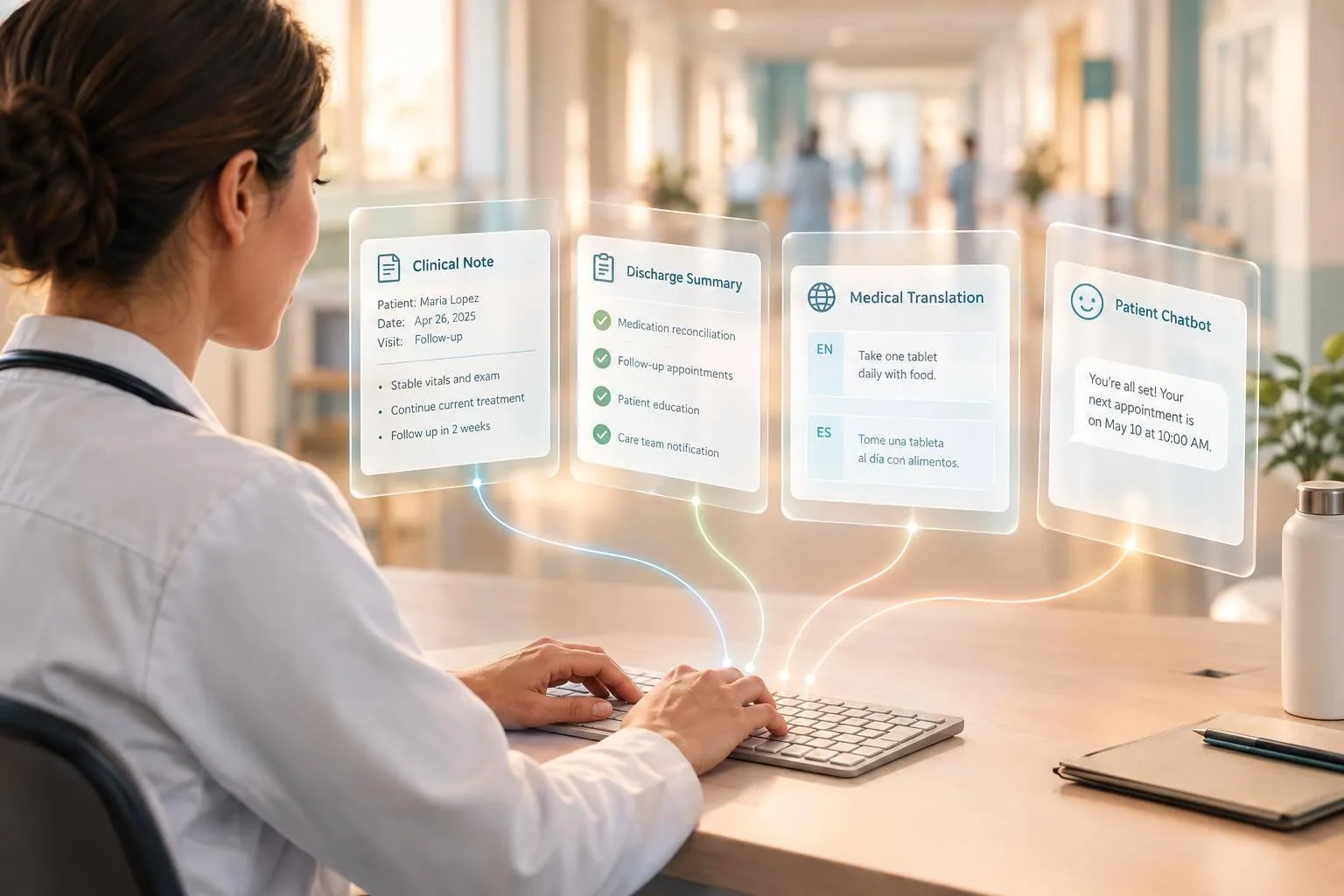
The video emphasizes summaries and discharge documentation. These are attractive applications because clinicians must reconcile information spread across multiple records.
A useful draft could reduce the effort needed to assemble that information. Yet the quality standard must extend beyond readability. Reviewers need to know:
- Did the summary preserve important findings?
- Did it distinguish current problems from historical ones?
- Did it omit uncertainty or conflicting documentation?
- Can the reviewer trace a statement to its source?
For an outpatient practice, the same reasoning applies to referral summaries and chart preparation. The value lies in reducing information-gathering effort while preserving a reliable path back to the record.
The video does not provide measured documentation time savings or error rates.
Supporting Patient Communication
The speaker identifies conversational assistants and translation as potential uses. Administrative communication offers a more bounded starting point than open-ended medical advice.
A practice might evaluate assistance with drafting appointment instructions, explaining routine scheduling processes, or preparing messages for staff approval. These tasks still require controls: incorrect preparation instructions can disrupt care, and an apparently administrative message may contain symptoms requiring clinical attention.
Translation deserves particular caution. A fluent translation does not establish that medical meaning has been preserved. Accuracy testing, review requirements, and escalation procedures for multilingual communication are not specified in the video.
Multimodal AI: Useful Potential, Uneven Risk
The video describes multimodal systems that work across text, images, audio, and video. This is relevant to healthcare because records rarely arrive in one clean format.
However, "multimodal" is not a quality guarantee. Consider the difference between:
- Reading a scanned registration form.
- Transcribing a patient encounter.
- Summarizing a laboratory report.
- Interpreting an X-ray.
Each task involves different inputs, failure modes, and clinical consequences. Success on one does not establish safety on another.
The video’s suggestion that reporting could occur without a pathologist or technologist is especially important to qualify. It supplies no supporting validation, regulatory status, or implementation evidence for such a workflow. That discussion should be read as a proposed application - not a basis for removing professional review.
Any diagnostic deployment would require a separate clinical, regulatory, and safety evaluation.
HIPAA and EMR Integration Are Part of the Workflow
The video explains possible uses but does not establish whether a particular implementation is suitable for protected health information (PHI). Its HIPAA arrangements and security controls are not specified in the video.
For U.S. practices, these questions belong near the beginning of evaluation:
- What PHI will the system receive?
- Where will information be processed and retained?
- Which vendors or subprocessors can access it?
- Will an appropriate business associate agreement be in place where required?
- Is submitted information used for model training?
- How are access, audit logs, retention, and deletion managed?
A business associate agreement alone does not establish that an entire workflow is HIPAA compliant. Policies, configuration, staff behavior, and security practices also matter.
Integration deserves equally concrete scrutiny. "Works with your EMR" could mean anything from generating text for manual copying to supporting a controlled, auditable review-and-write workflow.
Ask for a demonstration using the actual process:
- How does information enter the system?
- How is it matched to the correct patient?
- Who reviews the output?
- What is written back, and where?
- What happens when matching or extraction fails?
- Can staff see and correct the history of an action?
These implementation details are not specified in the video, but they determine whether the technology saves work or creates another application to manage.
Measure ROI After Review - not Before It
The video describes rapid processing, but speed claims alone do not establish operational value. No practice-level ROI results are provided.
A practical pilot should compare the existing workflow with the AI-assisted workflow using representative documents, including difficult cases.
| Measure | What it reveals |
|---|---|
| Staff time per completed item | Whether total handling effort decreases |
| Correction and exception rates | How much hidden review work remains |
| Time from referral receipt to next action | Whether work moves forward sooner |
| Referral completion rate | Whether improved intake supports completed care |
| Patient-matching errors | Whether information reaches the correct chart |
| Total implementation and operating cost | Whether benefits exceed the full expense |
A straightforward calculation is:
Net staff time reclaimed = baseline handling time − AI-assisted handling, review, correction, and oversight time.
Time reclaimed is not automatically payroll savings. It may instead create capacity for patient calls, follow-up, or backlog reduction. Likewise, a processed referral is not recovered revenue; downstream scheduling and completed visits must be measured separately.
A Practical Starting Point
For many practices, the strongest first project will be narrow, repetitive, and easy to review - not the most clinically ambitious application.
Choose one document type or administrative task. Define acceptable performance before testing. Include poor-quality scans, incomplete records, and ambiguous cases. Preserve a manual fallback, and assign responsibility for reviewing errors.
The video succeeds as an introduction to the breadth of language-based AI. Its limitation is that it surveys possibilities rather than proving operational readiness.
For healthcare leaders, that distinction is the foundation of a sound decision: evaluate LLMs by the work they reliably remove, the information they preserve, and the risks the practice can control - not by how convincingly they generate text.
Source: "AI in Healthcare 2026 | Real medical use cases, LLMs, GenAI & Future Jobs" - AD Academy, YouTube, Mar 31, 2026 - https://www.youtube.com/watch?v=svzXuhtsgrw
Fax management
Diagna reads every fax within minutes, 24/7. It sorts it, matches the patient, and sends it to the right person.
See how Diagna automates fax management