
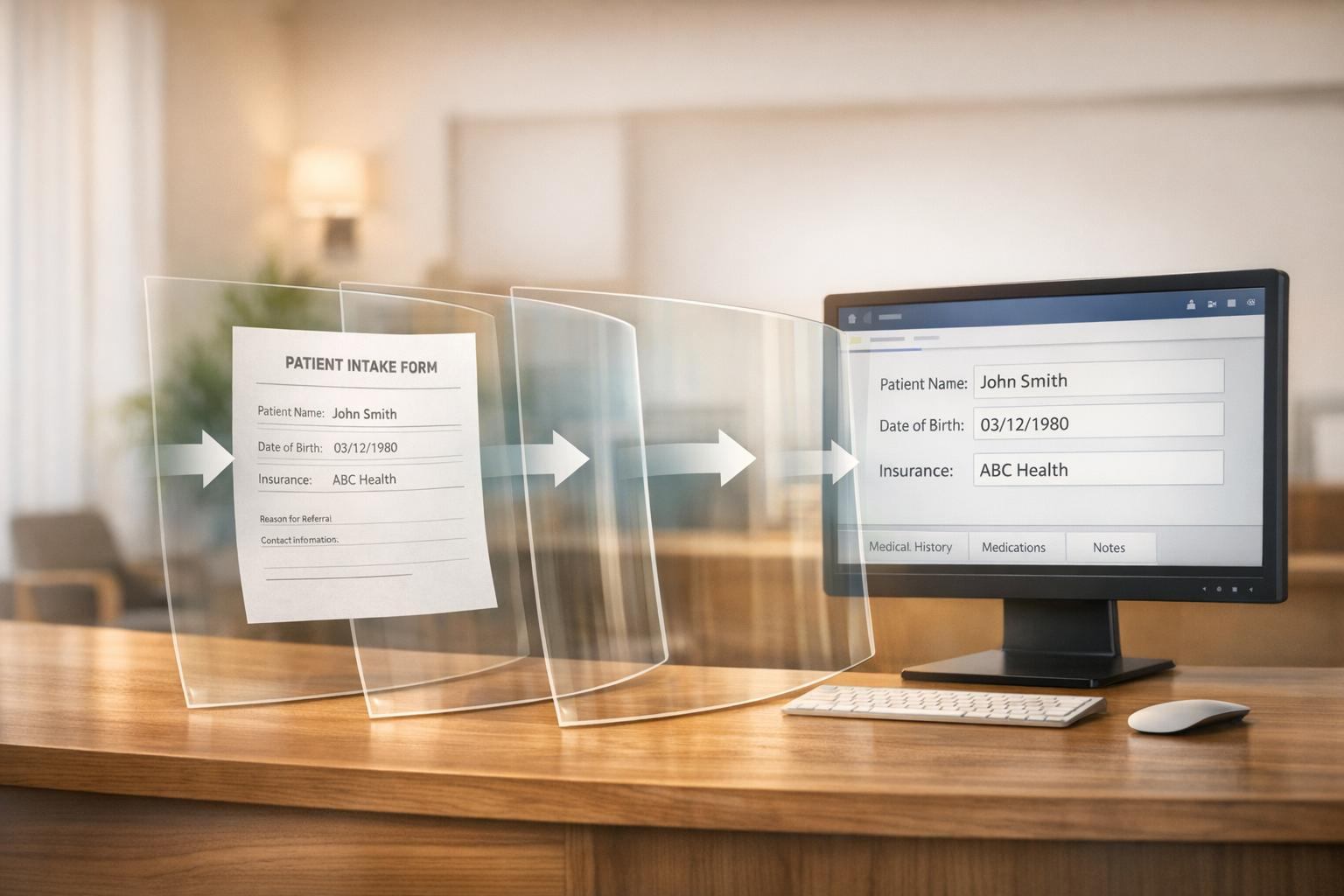
Patient intake is a major pain point for clinics, consuming hours of staff time and introducing errors that lead to missed appointments and denied claims. Over 75% of medical referrals are still sent via fax, requiring staff to manually re-enter data into EMR systems - taking 8 to 12 minutes per referral and contributing to a 1% to 4% error rate. These inefficiencies cost clinics time, money, and patient satisfaction.
The solution? EMR-integrated tools like Diagna's FAXFlo. These systems automate the intake process, extracting, matching, and routing patient information directly into EMR systems. This eliminates manual data entry, reduces errors, and saves staff up to 4 hours daily. Clinics can manage higher patient volumes without additional staff, improving efficiency and reducing burnout.
Key Takeaways:
- Manual Intake Challenges: Time-consuming (8 to 20 minutes per patient), error-prone (1% to 4%), and costly (claim denial rework costs $25 to $117 each).
- EMR Integration Benefits: Cuts data entry time by up to 90%, reduces errors to near zero, and saves 10+ hours weekly for clinics processing 50+ faxes daily.
- Scalability: Handles growing patient volumes without increasing staff, enabling clinics to focus on patient care.
If your clinic struggles with manual processes, EMR integration offers a faster, more accurate way to manage referrals and patient data.
1. Manual Patient Intake
Workflow Efficiency
Manual patient intake can be a bottleneck for clinics. When one patient's paperwork takes longer than expected, the entire day's schedule can be thrown off. Instead of focusing on patient care, staff often find themselves tied up with phone calls, sorting through faxes, and re-entering data.
As Tristan McGowan from IntakeDesk puts it:
"The industry may be digital in parts, but the front door is still frequently analog."
Take a typical referral packet - it can be 5 to 15 pages long. Staff must sift through these pages to determine urgency, flag missing lab results, and route the information appropriately. With 27% of referrals underestimated in urgency due to overwhelming unstructured data, the cracks in the process become clear.
These inefficiencies create ripple effects, leading to delays and compounding errors.
Accuracy and Error Reduction
Handwritten forms are another major pain point. Over half of these entries are illegible. When staff transcribe the information into the EMR, mistakes are inevitable. These errors are costly: 50% of all medical claim denials are linked to transcription issues, with 61% of those caused by simple demographic errors like misspelled names or incorrect insurance IDs.
And the price for fixing these mistakes? Reworking a single denied claim can cost anywhere from $25 to $117. Many clinics simply absorb these losses, adding unnecessary financial strain.
Time Savings
The time drain from manual intake is staggering. Patients spend an average of 22 minutes filling out forms, and staff spend another 8 to 20 minutes entering the same information into the EMR. For a clinic seeing 30 patients a day, this adds up to 11 hours of lost staff time each week. Double the patient load to 60, and you're looking at over 5 hours of lost time every single day.
These inefficiencies don’t just waste time - they limit a clinic's ability to grow and take on more patients.
Scalability
Manual processes simply can't keep up with growing patient volumes. Scaling up means hiring more staff, which isn't always feasible. Juan Pablo Montoya, Founder & CEO of Solum Health, sums it up well:
"Manual patient intake isn't just an inconvenience. It's a financial liability, a staffing crisis accelerant, and a patient satisfaction killer, all wrapped up in a process that most practices treat as an afterthought."
The stress on employees is another factor. A staggering 68% of front office staff report high stress levels directly tied to administrative tasks. This burnout drives turnover, which increases recruiting and training costs. On top of that, clinics spend about 3% of their annual revenue on paper, printing, and storage - expenses that grow with patient volume but offer no real value to the clinic.
These challenges highlight the pressing need for automated systems to simplify and improve the patient intake process.
2. EMR-Integrated Patient Intake (e.g., Diagna's FAXFlo)
Workflow Efficiency
EMR-integrated patient intake systems are changing how clinics handle faxes by automating the entire process. Tools like Diagna's FAXFlo can receive a fax, interpret its content, and send documents directly to the right provider or department - all without human intervention.
Sami Malik, CEO & Co-Founder of Linear Health, highlights the game-changing nature of this automation:
"The difference between reading a fax and acting on a fax is what separates automation from digitization. And it's what makes the 15-minute-per-fax burden disappear."
With EMR write-back capabilities, these systems can automatically populate extracted data - like patient information or clinical details - into specific fields in platforms such as Epic or athenahealth. No more tedious copy-pasting. This integration also enables downstream tasks, like insurance verification and prior authorizations, to kick off automatically. The result? Faster processing and fewer errors.
Accuracy and Error Reduction
Manual data entry is prone to mistakes, with error rates ranging from 1% to 4%. AI-powered systems tackle this issue by pulling structured data - such as patient demographics, insurance numbers, and clinical notes - directly from the source document and placing it into the correct EMR fields. By eliminating manual transcription, these tools significantly reduce the risk of errors that can lead to claim denials or delays.
Time Savings
Processing a single fax manually can take 15 to 20 minutes. AI integration cuts this time down to mere seconds. For clinics managing 50 faxes a day, that adds up to about 10 to 12.5 hours saved daily. In real-world use, Diagna's deployments have reported saving over 4 hours of staff time per day - more than 20 hours per week.
Scalability
One of the standout benefits of EMR-integrated systems is their ability to scale effortlessly. Around 80% of routine documents are processed automatically, with human intervention needed only for complex cases or low-confidence extractions. This approach means clinics can handle higher patient volumes without hiring additional staff.
Reza Ghomi, Co-Founder & Neuropsychiatrist at Frontier Psychiatry, puts it this way:
"What used to take hours of manual coordination now runs automatically, our patients get connected to specialists faster, and our staff finally have time to focus on care instead of follow-up calls."
Clinics using these systems report productivity gains of 30% or more. Plus, standardized workflows make it easier to expand operations across multiple locations without starting from scratch. This kind of scalability not only boosts efficiency but also transforms how clinics operate day-to-day.
Automating Patient Intake Fax Data into eClinicalWorks
Pros and Cons
Manual vs. EMR-Integrated Patient Intake: Key Stats Compared
Choosing between manual patient intake and an EMR-integrated approach involves weighing several factors. The best option depends on your clinic's patient volume, staff availability, and ability to manage administrative challenges.
| Feature | Manual Intake | EMR-Integrated (e.g., FAXFlo) |
|---|---|---|
| Data Entry Time | 8 to 20 minutes per patient | Up to 90% reduction in labor |
| Error Rate | 1% to 4% due to manual transcription | Near zero; data flows directly to EMR |
| Claim Denials | 61% of denials linked to manual errors | Significantly reduced via automated verification |
| Patient Wait Time | 15+ minutes in the waiting room | Forms completed at home; near-zero wait |
| Staff Burden | Heavy clerical workload; burnout risk | Shifted toward direct patient support |
| Compliance | Difficult to maintain physical audit trails | Built-in encryption and digital audit trails |
| Overhead Cost | ~3% of annual revenue in paper-related costs | 88% copay collection rate at time of service |
| Scalability | Throughput tied directly to headcount | Handles higher volumes without adding staff |
Manual intake methods come with notable time and cost burdens. The process is labor-intensive, prone to errors, and often results in longer patient wait times. These inefficiencies can ripple out, affecting claim approvals and staff workload.
On the other hand, EMR-integrated systems offer a streamlined solution. They drastically cut data entry time - up to 90% - while reducing errors to nearly zero. This improves claim processing, reduces patient wait times, and allows staff to focus more on patient care. However, implementing such systems typically takes 4 to 8 weeks, and clinics with limited IT resources might find the transition challenging.
It’s worth noting that simply digitizing faxes without full EMR integration doesn’t solve the core inefficiencies. As Tristan McGowan from IntakeDesk explains:
"A clinic may no longer have stacks of paper sitting next to a machine, but if staff still need to manually open documents... then the core operational burden remains. The medium has changed. The workflow has not."
This comparison highlights how integrated systems can transform clinic operations, setting the foundation for more efficient and patient-friendly workflows.
Conclusion
Manual patient intake is a drain on time, money, and accuracy. For example, a practice seeing 25 patients daily might lose over 1,000 staff hours each year to manual data entry. That’s time that could be redirected toward improving patient care.
Integrating with EMR systems offers a game-changing solution. When patient or provider data flows directly into the chart, manual entry becomes unnecessary. This reduces errors, shortens wait times, and allows staff to focus on what matters most - caring for patients. The efficiency benefits of this streamlined approach are hard to ignore.
For clinics still using paper forms and manually sorting faxes, tools like Diagna's FAXFlo provide a smart starting point. FAXFlo leverages AI to automatically receive, classify, and route incoming faxes, cutting out the manual triage process that typically takes 15 to 20 minutes per document. Plus, it integrates seamlessly with any EMR without requiring workflow changes, saving staff significant time every day.
If your clinic is struggling with high referral volumes or limited staff resources, now is the time to act. Solutions like these can make your intake process faster, more precise, and ready to scale.
FAQs
What does 'EMR write-back' mean?
Updating an electronic medical record (EMR) through 'EMR write-back' is an automated process that keeps patient information accurate and current. This involves integrating new or corrected data - often gathered during patient intake or other workflows - directly into the EMR. By doing so, clinics can maintain synchronized records, improve operational efficiency, and cut down on time spent on manual data entry.
How hard is it to integrate fax automation with my EMR?
Integrating fax automation with your EMR can be tricky, but it’s definitely doable with the right planning and setup. The key to success lies in factors like your EMR’s API capabilities and how your system is configured. Typically, a solid integration involves a two-layer structure: one layer manages fax transmissions (including retry logic), while the other handles status notifications. If you’re working with older systems, the process might take a bit more time, but with the right strategy, it’s still entirely possible.
How are exceptions handled when the AI isn’t confident?
If the AI isn't certain about a decision, the system automatically flags the case for manual review. This process helps uphold precision and security when dealing with patient information, ensuring top-tier standards for handling sensitive data.
Automated data entry
Diagna pulls patient, insurance, and diagnosis details off each document and enters them into the chart. No retyping.
See how Diagna automates EMR data entry