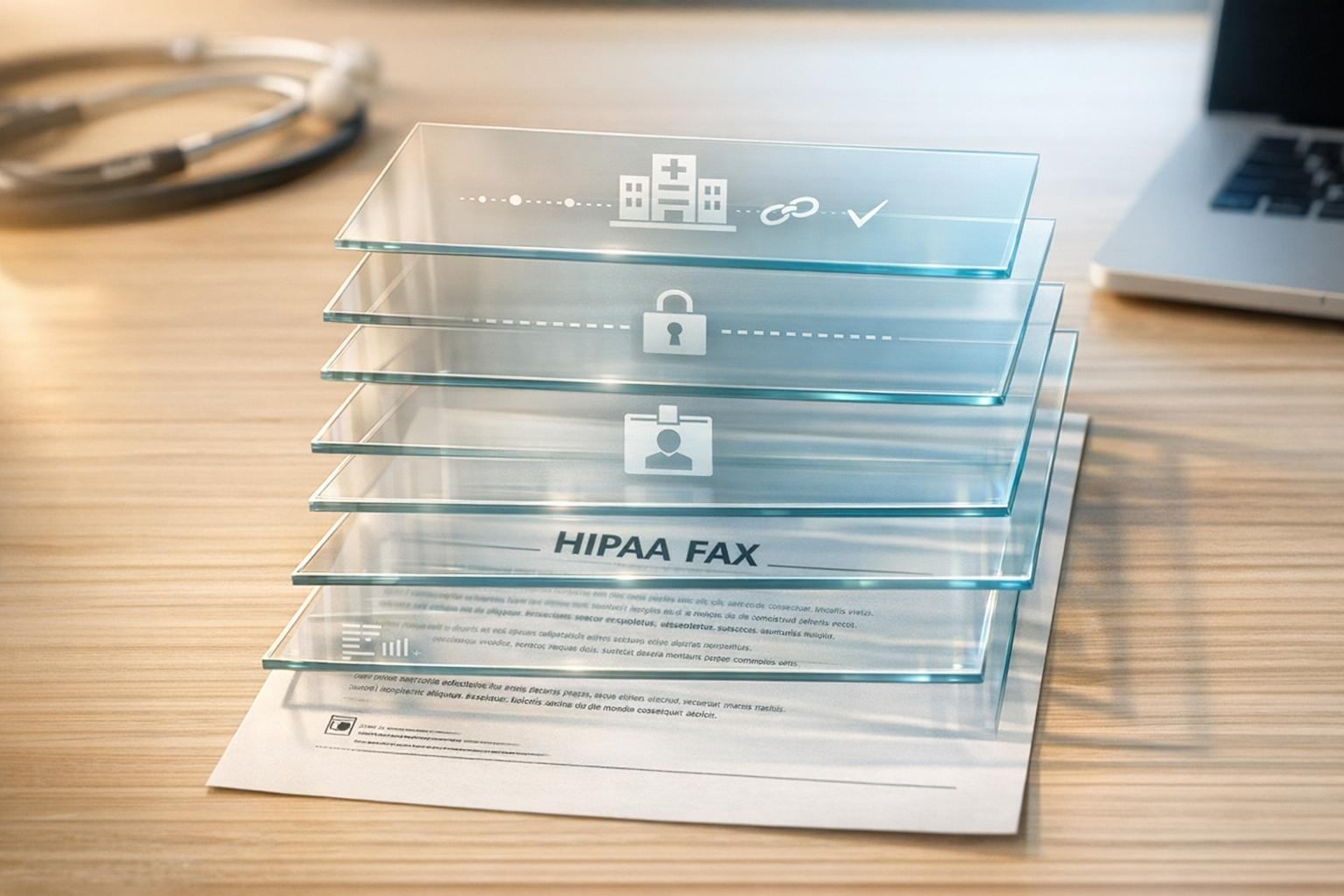
AI-powered fax systems are revolutionizing healthcare communication by addressing security gaps, improving efficiency, and ensuring compliance with HIPAA regulations. Here's what you need to know:
- Why Faxing Still Dominates in Healthcare: Over 70% of U.S. healthcare providers rely on fax due to its simplicity in handling interoperability issues between different IT systems and its reduced exposure to online threats.
- HIPAA Compliance Challenges: Analog fax machines often fail to meet security standards like encryption (TLS 1.2+ and AES-256), audit logs, and access controls, leading to risks of data breaches and hefty penalties.
- AI-Powered Solutions: AI enhances fax security by automating document classification, routing, and audit trails with high accuracy (95 to 98%). It also integrates seamlessly with EHR systems, reducing manual errors and processing time.
- Key Benefits: Faster workflows, reduced errors, and compliance with HIPAA standards. For example, AI can cut manual processing time by 70 to 85%, saving healthcare providers significant time and money.
AI-driven fax systems, like Diagna's FAXFlo, combine advanced technology with secure practices, making faxing safer and more efficient for healthcare providers.
AI-Powered Document Recognition and Routing
OCR and Machine Learning
AI-powered fax systems begin by transforming faxed images into machine-readable text using Optical Character Recognition (OCR). Modern OCR technology achieves impressive accuracy - over 99.9% for medical documents - converting static fax images into searchable, structured data. From there, Intelligent Document Processing (IDP) steps in, leveraging machine learning and natural language processing to classify and extract key information from unstructured fax formats.
The classification engine analyzes the document's structure, uses computer vision to identify logos and signatures, and applies pattern matching to determine whether the fax is a referral, lab result, prior authorization, or consult note. AI also automatically extracts critical patient details, such as names, dates of birth, Medical Record Numbers (MRN), and ZIP codes. Considering that a typical 500-bed hospital generates about 50 terabytes of data annually, with 80% of it in unstructured formats, this automated extraction is essential for maintaining efficiency. This accuracy in data extraction paves the way for smooth, automated document routing.
Automated Document Routing
After classification, the next step is automated routing, where AI directs documents to the right department or patient chart without manual effort. A great example is Diagna's FAXFlo (https://diagna.ai), which receives, reads, categorizes, and routes incoming faxes. This eliminates the need for staff to sort and file documents manually. The platform boasts 98%+ accuracy in document processing and integrates seamlessly with any EMR system, ensuring that faxes are routed directly into the correct patient records.
Advanced routing systems factor in multiple variables, including document type, urgency (e.g., STAT orders), provider preferences, and department workload. For example, referrals are sent to referral coordinators, lab results with critical values are flagged for clinical review teams, and prior authorization responses are matched to original requests and forwarded to insurance verification teams. This AI-driven triage process can cut document sorting time from 3 to 5 minutes per document to under 30 seconds.
Accuracy and Error Reduction
AI not only speeds up processing but also significantly reduces errors. While manual document classification typically achieves 85% to 90% accuracy, AI far surpasses this. For a practice handling 100 faxes daily, AI can reduce manual processing time from 23 hours to just 3 hours, potentially saving $120,000 annually.
To maintain data integrity, AI systems use confidence scoring during routing. Documents with low-confidence scores - often caused by issues like poor handwriting, transmission errors, or degraded image quality - are flagged for human review. This ensures that ambiguous cases get the attention they need while high-confidence documents are processed automatically. Handwritten notes remain a challenge, with accuracy rates between 70% and 85%, requiring verification, but printed text is handled with near-perfect precision.
Integration with EHR Systems
Direct API Integration
AI-driven fax solutions are transforming how healthcare facilities handle data by connecting directly with EHR systems through secure REST APIs. This approach ensures compliance with HIPAA security standards while automating data transfer. Instead of relying on manual input, these systems automatically extract and populate key patient information into the appropriate EHR fields, such as demographics, insurance details, and clinical notes.
One standout feature is the write-back capability, which eliminates the need for tedious copy-pasting. Major EHR platforms like Epic, Cerner, athenahealth, and eClinicalWorks already support these API integrations.
"The make-or-break factor is EHR integration depth: does the system write directly to the EHR, or does it just extract to a clipboard?" - Sami Malik, CEO & Co-Founder, Linear Health
When a fax is received, AI tools can match the data to existing patient records or create new entries, preventing duplicate records. This system also links incoming documents like consultation notes or lab results back to the original referral or order within the EHR, ensuring comprehensive documentation without requiring additional manual work.
By enabling this smooth, automated flow of information, these integrations enhance workflows without disrupting established processes.
Non-Disruptive Workflow Compatibility
Accuracy is critical, but so is preserving the workflows that healthcare teams already know and trust. Modern AI fax solutions are designed to complement existing EHR systems rather than replace them. This means staff can continue using familiar interfaces while the AI handles tasks like data entry, routing, and chart creation behind the scenes.
Take Diagna's FAXFlo (https://diagna.ai) as an example. It integrates seamlessly with any EMR system, allowing clinics to maintain their current workflows. The platform consolidates documents from various sources - fax, email, and uploads - into a single digital inbox. From there, it automatically organizes files into categories like referrals, prior authorizations, and denials. This streamlined process saves healthcare teams over 20 hours each week by eliminating manual document handling. Plus, with cloud-based access, installation is quick, and no additional hardware is needed.
Applying Automation and AI to Faxes and Documents at VHC Health
How AI Strengthens HIPAA Compliance
Manual Fax vs AI-Powered Fax Security Comparison for HIPAA Compliance
Encryption and Data Security
Traditional fax machines rely on unencrypted analog tones transmitted over phone lines, leaving them open to interception. AI-powered cloud fax systems, however, use digital Fax-over-IP (T.38), which supports end-to-end encryption - a level of security analog systems simply can't match.
These modern systems employ AES-256 encryption for data stored at rest and TLS 1.2 or higher for data in transit. The encryption happens automatically, removing the need for manual setup. Additionally, AI fax systems include automatic data purging, ensuring that sensitive health information is deleted from active memory immediately after a transaction is completed. This eliminates a common vulnerability in physical fax machines, where patient data can linger in memory and remain accessible even after the device is discarded.
Such encryption measures lay the groundwork for advanced access controls and auditing, further aligning these systems with HIPAA requirements.
Access Controls and Audit Logs
AI-powered systems go beyond encryption by implementing strict access controls to safeguard protected health information (PHI). According to HIPAA Security Rule §164.312(a) and (b), systems handling PHI must have unique user identification and detailed audit controls. AI fax platforms enforce Role-Based Access Control (RBAC), so staff members only access documents relevant to their roles. Unlike shared passwords or open access to a fax machine tray, these systems require Multi-Factor Authentication (MFA) and can integrate with Single Sign-On (SSO).
"The compliance obligations do not change because the accessing system is automated. HIPAA's Privacy Rule, Security Rule, and Breach Notification Rule were written around the data, not the person or system reading it." - Danielle Barbour, Security and Compliance Expert, Kiteworks
AI systems also produce immutable audit trails that log who accessed data, when, and for what purpose. These logs provide a comprehensive chain of custody with real-time monitoring. HIPAA mandates that such logs be retained for at least six years, and AI systems manage this retention automatically.
Manual Fax Risks vs AI-Driven Security
Even with encryption and access controls, traditional fax processes still carry significant risks due to manual handling. For instance, manual document routing has an error rate of 5 to 8%, which can lead to misdirected PHI and potential HIPAA violations. Physical fax machines also pose risks, such as data recovery from unsanitized internal memory or unauthorized access to documents left in trays. With HIPAA violation penalties in 2024 ranging from $141 to $2,134,831 per violation, these vulnerabilities can be costly.
A comparison table highlights how AI-powered systems outperform manual workflows in critical security areas:
| Security Feature | Manual/Analog Fax Workflow | AI-Powered Cloud Fax |
|---|---|---|
| Encryption (Transit) | None (analog audio tones) | TLS 1.2+ (NIST SP 800-52) |
| Encryption (Rest) | None (stored in device memory) | AES-256 (FIPS 197) |
| Access Control | Physical locks/shared trays | RBAC, MFA, and SSO |
| Audit Controls | Manual logs (often incomplete) | Immutable, automated digital logs |
| Data Entry | Manual transcription (1 to 3% error rate) | AI-OCR automated extraction (99%+ accuracy) |
| Routing | Manual sorting (5 to 8% error rate) | Automated intelligent routing (95 to 98% accuracy) |
AI-driven systems significantly reduce routing errors to 95 to 98% accuracy and virtually eliminate data entry mistakes. In 2025, the Office for Civil Rights issued over $6 million in HIPAA penalties to small and mid-sized healthcare organizations. By automating compliance controls, AI systems can help prevent these costly penalties.
How to Implement AI-Powered HIPAA Fax Security
AI's precision and compliance capabilities can transform fax workflows in healthcare. Here's a step-by-step guide to implementing a secure AI-powered fax solution.
Step 1: Assess Current Fax Workflows
Start by mapping out every point where patient data is handled. This helps pinpoint which AI tools are needed for tasks like processing diagnosis codes or insurance details. Measure the administrative load by tracking how much time staff spend on each fax - typically 2 to 4 minutes for sorting, reading, and routing - and multiply that by your daily volume.
Look into error rates and delays. Manual fax systems misroute documents 5 to 8% of the time, causing patient care delays of 2 to 5 days per mistake. Conduct a formal security risk analysis, as required by the HIPAA Security Rule (§164.308(a)(4)(ii)(A)), to identify vulnerabilities like unencrypted phone lines or unattended paper trays. Also, decide if additional integration tools are necessary or if a shift to cloud-based systems is feasible. Keep in mind that AI can process faxes in 5 to 10 minutes compared to the 30 to 90 minutes it takes manually.
With this analysis, you'll have a clear understanding of your current system's gaps and can choose an AI solution that fits your needs.
Step 2: Select a HIPAA-Compliant AI Solution
A Business Associate Agreement (BAA) is a must-have. Before diving into features or pricing, confirm that the vendor is willing to sign a BAA.
"If a vendor won't sign a BAA, they cannot touch your patient data. This is the first and most important filter." - Heph, AI COO at BAM
Look for a solution with SOC 2 Type II certification. Opt for platforms offering REST APIs or direct integration with major EHR systems to ensure smooth workflows. Ask vendors about their sub-processors and confirm that BAAs are in place for any third-party AI APIs they use. To avoid legal complications, insist on US-only data storage.
For instance, Diagna's FAXFlo offers AI-powered fax triage with over 98% accuracy while maintaining HIPAA compliance through signed BAAs and seamless integration with EMR systems.
Once you've chosen a compliant AI solution, the next step is to configure and test it for your organization.
Step 3: Configure and Test the Solution
Set up individual user accounts with unique IDs - shared credentials should be avoided. Implement measures like Role-Based Access Control (RBAC), Multi-Factor Authentication (MFA), Single Sign-On (SSO), and automatic session timeouts to ensure staff only access documents relevant to their roles.
Configure intelligent routing rules to automatically direct faxes to the correct departments based on document type. Establish automatic deletion timelines or a zero-retention policy to ensure PHI is purged immediately after transactions. Test the system by sending incomplete forms or documents with missing identifiers to confirm that the AI flags them correctly for manual review. Make sure the system generates immutable audit logs that meet HIPAA's logging requirements. Importantly, avoid transmitting PHI during the setup or trial phases until a BAA is signed.
A well-configured system with thorough testing minimizes errors and strengthens HIPAA compliance.
Benefits of AI in HIPAA Fax Security
Efficiency Gains
AI-driven fax automation can drastically cut down the time spent on administrative tasks in healthcare. For instance, a mid-sized practice handling 50 faxes daily could save around 10 hours previously tied up in manual data entry. Larger practices managing 100 faxes a day could reduce their manual processing workload from 23 hours to just 3 hours per day. This translates to potential annual savings of approximately $120,000. AI systems can process up to 80% of incoming faxes without human involvement, freeing staff to focus on patient care instead of repetitive administrative duties.
But it’s not just about time savings. AI also strengthens security by addressing vulnerabilities associated with manual fax handling.
Compliance and Risk Reduction
AI eliminates common physical risks like unattended paper trays, stored faxes in device memory, and unencrypted phone lines. Automated routing significantly reduces the chance of misdirected faxes caused by manual errors - a frequent source of HIPAA violations. Additionally, AI systems generate detailed, unalterable audit logs for every fax transaction, ensuring compliance with 45 CFR §164.312(b). Modern AI-powered OCR (Optical Character Recognition) technology boasts accuracy rates above 99.9% for medical documents, minimizing human errors that could lead to compliance breaches.
By addressing these risks, AI not only ensures regulatory compliance but also delivers tangible financial benefits.
Measurable ROI
AI also plays a role in preventing referral leakage, a common issue where patient referrals fail to convert into appointments. With faster processing times, specialty practices can generate an extra $4,000 to $10,000 in monthly revenue by ensuring more referrals are completed.
A real-world example of this is Diagna's FAXFlo platform. In live deployments, it has saved over 4 hours of staff time daily and achieved a document processing accuracy rate of over 98%. Its referral tracking feature reduces scheduling delays from 48 to 72 hours to same-day appointments, boosting both revenue and patient satisfaction.
These benefits clearly show how AI can transform fax workflows into secure, efficient systems that not only meet regulatory standards but also enhance patient care and operational performance.
Conclusion
Healthcare organizations can no longer afford to overlook the importance of fax security. The growing risks associated with unsecured faxing have pushed providers to embrace AI solutions that not only safeguard Protected Health Information (PHI) but also improve day-to-day operations.
Switching from outdated analog fax machines to AI-driven cloud platforms isn't just about meeting compliance requirements. It's about transforming faxing into a secure and efficient workflow. AI tools bring advanced features like highly accurate OCR technology (with over 99.9% accuracy), automated and secure document routing, and immutable audit logs, ensuring every step of the process is streamlined and protected. These advancements help safeguard patient data, cut administrative costs, and improve care coordination.
"AI should support, not replace, the strict safeguards mandated by HIPAA regulations." - Kent Cañas, Content Strategist, iFax
To move forward, healthcare organizations must take essential steps: ensure Business Associate Agreement (BAA) coverage, enforce strong encryption protocols like TLS 1.2+ and AES-256, and implement strict access controls using Multi-Factor Authentication (MFA) and Role-Based Access Control (RBAC). Retiring legacy fax machines should only happen after following certified media sanitization guidelines outlined in NIST SP 800-88. By combining these measures with AI-driven automation, organizations can establish a secure, efficient foundation for compliance and operational success.
For clinics looking to modernize their fax processes, platforms like Diagna's FAXFlo showcase the potential of AI-powered solutions. These tools not only streamline workflows but also ensure secure, accurate document handling, turning what was once a challenge into a valuable operational advantage.
FAQs
Will AI faxing still work if we keep our current fax numbers and workflows?
AI faxing integrates seamlessly with your existing fax numbers and workflows. These AI-driven solutions improve security and compliance by incorporating features such as encryption and delivery tracking - without disrupting your current processes.
How does an AI fax system handle faxes with handwriting or poor image quality?
AI fax systems leverage cutting-edge OCR (Optical Character Recognition) and automation tools to handle handwritten notes and low-quality images with precision. These technologies can extract key information even from hard-to-read faxes, ensuring that data is captured securely and reliably. Plus, they adhere to healthcare regulations like HIPAA, so compliance is always maintained.
What should we ask a vendor to prove HIPAA compliance (BAA, encryption, logs)?
To meet HIPAA requirements, ask the vendor for a Business Associate Agreement (BAA). Additionally, they should prove that data is encrypted both during transmission and while stored. It's also crucial that they keep thorough audit logs. These steps confirm the vendor adheres to the required security and privacy protocols.
Fax management
Diagna reads every fax within minutes, 24/7. It sorts it, matches the patient, and sends it to the right person.
See how Diagna automates fax management