Checklist for AI-Driven Prior Authorization Setup
Prior Authorization
Prior Authorization
Five-step checklist to implement AI-driven prior authorization with governance, EHR integration, testing, training, and CMS compliance.
Five-step checklist to implement AI-driven prior authorization with governance, EHR integration, testing, training, and CMS compliance.

Manual prior authorization (PA) processes are slow, costly, and error-prone. AI-driven PA tools can reduce processing times from days to hours, cut costs, and improve accuracy. Here's a quick breakdown of what this article covers:
Why Automate PA?
Manual PA costs $20–$75 per request and takes 13 hours weekly for staff.
AI reduces manual work by 50–70%, saving time and money.
Key Compliance Deadlines
By January 1, 2027, Medicare and Medicaid payers must adopt FHIR-based APIs for PA.
Urgent PA requests must be processed within 72 hours, standard ones in 7 calendar days.
Steps for Implementation
Governance & Compliance: Ensure HIPAA compliance, use secure systems, and monitor AI outputs.
Workflow Integration: Link AI to EHR systems for smooth data extraction and submission.
AI Configuration: Test accuracy, monitor performance, and use human oversight for complex cases.
Operational Readiness: Train staff, define roles, and plan for seasonal workload spikes.
Front-Office Integration: Align PA processes with referrals and document workflows.
Tools & Metrics
Use AI with natural language processing to extract clinical data from unstructured notes.
Track metrics like first-pass approval rates and "need more information" loops to measure success.
AI-driven PA tools offer a faster, more efficient way to handle authorizations, allowing clinics to focus on patient care while staying compliant with evolving regulations.
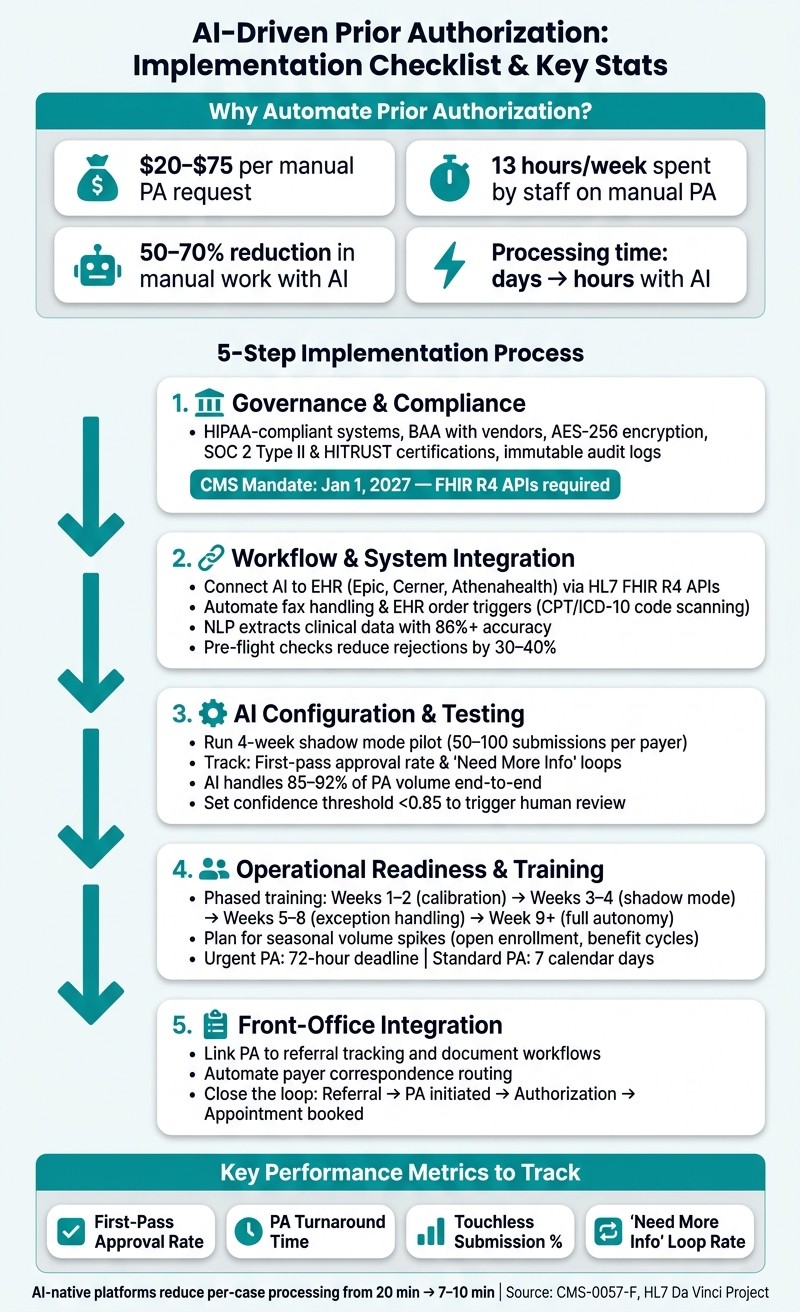
AI-Driven Prior Authorization Setup: 5-Step Implementation Checklist
CMS Interoperability : Reimagining Prior Authorization with Conversational AI
Governance, Compliance, and Risk Management
Before diving into any AI-powered Prior Authorization (PA) tools, it's essential to establish a solid governance framework. Skipping this step can lead to compliance headaches after implementation - a far more disruptive situation than addressing potential issues from the outset.
Regulatory Alignment
A critical deadline looms: January 1, 2027. By this date, the CMS Interoperability and Prior Authorization Final Rule (CMS-0057-F) mandates that Medicare Advantage, Medicaid, CHIP, and ACA Marketplace plans adopt FHIR R4-based APIs for PA transactions. Some requirements under this rule kick in even earlier, on January 1, 2026. These include strict timelines: 72 hours for urgent requests, 7 calendar days for standard requests, and a mandate for payers to provide specific clinical reasons for denials in electronic responses.
Your AI tool should be designed to meet these deadlines from day one. Check if your vendor supports the HL7 Da Vinci Project's key implementation guides: Coverage Requirements Discovery (CRD), Documentation Templates and Rules (DTR), and Prior Authorization Support (PAS). These guides form the backbone for FHIR-based PA automation. Additionally, see if the vendor monitors approval rates at the provider level. This is particularly important in states like Texas and Virginia, where "gold carding" laws exempt high-performing providers from certain PA requirements. Your AI should flag when your clinic qualifies.
HIPAA and Data Security Requirements
If your AI vendor handles patient health information (PHI), they must sign a Business Associate Agreement (BAA). This agreement should explicitly prohibit the vendor from using your clinic's PHI to train models for other clients.
Demand robust security measures, including AES-256 encryption for data at rest and TLS 1.2 or higher for data in transit. Multi-factor authentication (MFA) and role-based access controls (RBAC) are also essential. Additionally, ensure that all AI-assisted activities are logged in immutable audit trails. These logs aren't just for compliance - they serve as your defense in case a payer challenges a medical necessity determination. Look for third-party certifications like SOC 2 Type II and HITRUST, which signal that the vendor's security practices have undergone rigorous external evaluations.
"Traditional HIPAA assessments... miss AI-specific risks like model inversion attacks, training data exposure, and prompt injection vulnerabilities." - BrianOnAI
Once security measures are in place, the next step is ensuring clinical oversight seamlessly bridges technology with patient care.
Clinical Oversight and Decision Boundaries
While AI can handle drafting, assembling, and even submitting PA requests, a licensed clinician must always review and sign off before submission - especially for complex, costly, or previously denied cases. This aligns with both regulatory requirements and industry commitments. By 2027, major health plans aim for at least 80% of electronic PAs with complete documentation to receive real-time responses. Achieving this goal depends on accurate, clinically verified documentation.
Establish clear "stop-rule" triggers in your workflow - specific scenarios where the AI must pause and escalate the case to a human reviewer. As ProofMD notes:
"The best governance programs make pause decisions automatic, not political."
Document these rules, assign responsibility for each escalation path, and review the process quarterly to stay aligned with evolving payer policies. These governance practices ensure your clinic integrates AI tools effectively into its operations while maintaining compliance and quality care standards.
Workflow and System Integration
Once your governance and compliance foundation is established, the next step is connecting AI-powered prior authorization (PA) tools to your clinic’s day-to-day operations. A well-designed system should integrate smoothly into existing workflows, avoiding the need for staff to learn entirely new processes. This integration also enables feedback loops that refine AI configurations over time, enhancing the overall PA process.
PA Initiation and Trigger Points
Timing is critical for PA automation. The two main trigger points are EHR order entry (when a clinician orders a procedure, medication, or diagnostic test) and inbound fax receipt (when PA-related documents are sent by referring providers or payers). Identifying the need for authorization at these points - rather than later - helps avoid delays.
Inbound faxes are often overlooked in PA workflows, especially in independent specialty clinics. Many PA requests, referrals, and supporting clinical documents still come in via fax, requiring staff to manually sort through them - a time-consuming process. Tools like Diagna's FAXFlo address this issue by automating fax handling. These systems identify PA-related documents and route them to the appropriate person or queue instantly, eliminating manual sorting.
For EHR-based triggers, AI tools can scan for specific CPT and ICD-10 codes and payer details during order entry. This ensures that cases needing authorization are flagged immediately, preventing scenarios where a procedure is scheduled before anyone realizes a PA is required.
By automating these triggers, your clinic can set the stage for accurate data extraction and mapping.
Data Extraction and Mapping
Once a PA case is initiated, the AI system must extract the necessary clinical and administrative data and align it with payer-specific requirements. This can be challenging since payer requirements vary widely, and much of the critical clinical information resides in unstructured free-text notes instead of neat, structured fields.
Modern AI tools leverage Natural Language Processing (NLP) to analyze progress notes, lab results, and imaging reports. These tools can extract key details like "failure of conservative therapy" or documented comorbidities. Large language models (LLMs) achieve over 86% accuracy in extracting clinical evidence from unstructured notes, outperforming older OCR tools that merely convert images to text without understanding context.
After extraction, data normalization is essential. Using shared clinical vocabularies like SNOMED CT and LOINC ensures compliance with payer-specific FHIR requirements. A "pre-flight check" step can validate submissions, catching errors or missing fields before sending the request. This step alone can reduce rejection rates by 30% to 40%.
EHR/EMR Integration
For a seamless experience, your AI PA tool should integrate directly with your existing EHR system without disrupting current workflows. Most systems rely on HL7 FHIR R4 APIs to pull structured clinical data from platforms like Epic, Cerner, or Athenahealth, while SMART on FHIR (OAuth 2.0) ensures secure authentication.
Key integration features include automatic PA status updates and staff notifications. Once a payer decision is made, the AI should update the order status in the EHR and notify the appropriate staff members - eliminating the need for manual portal checks. If your vendor cannot provide this functionality, the integration is incomplete.
"We would actually argue that there's more clinical rigor when we're pulling that clinical information from the EHR - versus the manual entry that goes on with prior authorization today." - Lauren Hackenberg, Senior Director of Provider Capabilities, Optum
To ease the transition, consider starting in "shadow mode". In this setup, the AI processes PA requests alongside your current staff for about four weeks. This allows you to verify accuracy and build trust in the system before fully switching over.
Once EHR integration is running smoothly, the next step is fine-tuning AI configurations and monitoring its performance.
AI Configuration and Performance Monitoring
Once your EHR integration is up and running, the next step is making sure your AI system delivers consistent results - not just at launch, but long-term. This requires setting clear performance goals and keeping a close eye on its operations.
Accuracy Targets and Testing
Start by collecting 90 days of historical prior authorization (PA) data, broken down by payer, CPT codes, and turnaround times. This will give you a solid baseline to measure performance. From there, test the AI in shadow mode - processing PA requests alongside your staff but without submitting them autonomously. Only move to full automation after successfully logging 50–100 shadow submissions for each key payer-service combination.
Two critical metrics to monitor include:
First-pass approval rate: How often a PA gets approved without needing resubmission.
"Need More Information" loops: These indicate when the AI misses crucial clinical details in its initial submission.
AI-native platforms, when paired with strong data extraction processes, can handle about 85–92% of PA volume from start to finish.
"The gap between practices that automate PA in 2026 and the ones that don't is going to be the biggest operational divergence in the revenue cycle this decade." - Sayem Hoque, CEO, Flexbone
Human-in-the-Loop Review
AI should never make final PA decisions without human oversight. A supervisory model works best: the AI prepares submissions and supporting evidence, but a clinician or trained staff member reviews and approves them before release. Some states, like Texas, Arizona, and Maryland, have even passed laws requiring human review for adverse determinations made by automated systems.
This approach reduces automation bias. Train your team to see AI recommendations as starting points, not definitive answers. To streamline the process, ensure AI outputs are directly tied to clinical evidence in the EHR. When reviewers can quickly verify supporting notes or lab results, approvals happen faster. Also, set clear escalation triggers - for instance, flagging cases the AI can't classify or when audit completion rates drop below a certain threshold. These cases should be immediately routed to a human supervisor.
Once human review processes are established, focus on creating feedback loops to refine the system’s performance.
Feedback Loops and Continuous Improvement
AI systems need regular input from your team to improve. Schedule weekly meetings with a small group of staff from different disciplines to review exception reports, payer denials, and cases where AI recommendations were overridden. Track denial rates by service type, and if the system misses quality benchmarks for two consecutive cycles, pause automation to reassess. Over time, this feedback helps the AI adapt to the unique needs of your practice.
"AI doesn't replace human oversight. Instead, it efficiently pre-filters claims, highlighting those clearly necessary... and the gray areas requiring human expertise." - Ankita Patel, M.D., Senior Physician Advisor, Xsolis
Keep an eye out for automation drift, where AI accuracy gradually declines, leading to more corrections by staff. To prevent this, include a monthly chart audit in your routine. Regular monitoring and updates will ensure the system stays reliable and effective.
Operational Readiness and Change Management
Getting your team operationally ready means clearly defining roles, planning for capacity, and ensuring that prior authorization (PA) processes align seamlessly with front-office workflows.
Staff Roles and Training
AI doesn’t replace staff - it reshapes their responsibilities. For example, PA coordinators move from repetitive tasks like manual data entry to more impactful roles, such as managing peer-to-peer reviews, handling appeals, and acting as clinical liaisons. To ensure this transition goes smoothly, training must be tailored to specific roles. Clinicians, nursing staff, and operations teams all interact with the AI system in unique ways, so generic training won't cut it. Keep it focused and relevant to avoid disrupting workflows.
A phased training approach works best:
Training Phase | Focus Area | Key Staff Involved |
|---|---|---|
Weeks 1–2 | Baseline capture & calibration | Clinical Leads, Ops Owners |
Weeks 3–4 | Supervised shadow mode testing | PA Coordinators, Nursing Staff |
Weeks 5–8 | Exception handling & escalation testing | All PA Staff, Supervisors |
Week 9+ | Progressive cutover to autonomous ops | Full Revenue Cycle Team |
To build trust in the system and catch errors early, train at least two clinicians to validate AI outputs. Provide clear, standardized prompt patterns, output templates, and review criteria so staff can interact with the system consistently - no guesswork involved.
"Reliable execution depends on repeatable output and explicit reviewer accountability, not ad hoc variation by user." - ProofMD
These steps lay the groundwork for a compliant and efficient AI-driven PA system.
Volume and Capacity Planning
Start by analyzing 90 days of PA history, breaking it down by payer, CPT codes, and channels. Focus on high-volume combinations to maximize efficiency. AI agents can manage around 85–92% of the workload end-to-end, leaving the more complex 8–15% for your team to handle.
Be prepared for seasonal spikes, such as the start of new insurance benefit cycles or open enrollment periods. These events can significantly increase PA requests, potentially overwhelming both your AI system and staff if you’re not ready. Use triage strategies to prioritize urgent cases - like medication and surgery requests - over routine ones. Remember, under the CMS-0057-F mandate (effective January 2026), standard PA decisions must be made within 7 calendar days, while urgent requests have a 72-hour deadline.
"Automation allows human intelligence to focus on the 20% of cases that require more thorough review." - Matt Cunningham, Executive Vice President of Product, Availity
With these insights, you can ensure your system is ready to handle demand while keeping compliance top of mind.
Connecting PA to Referral and Document Workflows
To avoid delays and patient leakage, PA processes must integrate seamlessly into referral and document workflows. Prior authorization isn’t an isolated process - it’s part of a larger chain that starts with referrals and ends with scheduled appointments. Any gaps along the way can disrupt the patient experience.
Platforms like Diagna address these challenges head-on. For instance, Diagna’s FAXFlo automates the handling of incoming faxes, including payer correspondence related to PA decisions. It categorizes and routes these documents without manual intervention. Pair this with Diagna’s Referral Manager, which tracks every referral from receipt to appointment scheduling, and you’ve got a closed-loop process: referral received, PA initiated, authorization confirmed, and appointment booked. This seamless integration ensures no authorizations are missed before patient appointments.
Key Takeaways for AI-Driven PA Success
Implementing AI-driven prior authorization (PA) systems involves deliberate planning and execution. Start by assessing your current PA workload - evaluate denial rates, staff hours, and overall volume. Before deploying automation, map payer-specific clinical criteria to your EHR data. A shadow mode pilot, running for 4–8 weeks, can help validate AI outputs and build team confidence before transitioning to full autonomy.
Compliance and ongoing monitoring are essential at every stage. Keep immutable audit logs, adhere to HIPAA's Minimum Necessary Standard, and set clear confidence thresholds (typically below 0.85) to trigger human review. Additionally, track key performance indicators (KPIs) like first-pass approval rates, turnaround times, and touchless submission percentages to ensure operational effectiveness.
The benefits of automating PA are substantial. AI can manage 85–92% of routine PA tasks from start to finish, cutting per-case processing times from 20 minutes down to just 7–10 minutes.
For independent specialty clinics, tools like Diagna’s integrated AI solutions extend these efficiencies to front-office operations. For example, FAXFlo automates the handling of payer correspondence, including authorization decisions, while the Referral Manager tracks every referral from receipt to scheduled appointment. Real-world deployments show these tools can save over four hours of staff time per day, achieving an impressive 98%+ accuracy in document processing.
"The gap between practices that automate PA in 2026 and the ones that don't is going to be the biggest operational divergence in the revenue cycle this decade." - Sayem Hoque, CEO, Flexbone
This highlights the widening divide between early adopters and those lagging behind. Embracing AI-driven PA not only saves time but also allows staff to concentrate on delivering direct patient care, underscoring the urgency of taking action now.
FAQs
What’s the fastest way to pilot AI prior authorization safely?
To roll out AI-driven prior authorization effectively and efficiently, begin by evaluating your current processes and identifying areas ripe for improvement. Start with automating repetitive, high-volume tasks such as eligibility checks and status updates. These tasks are typically rule-based, making them ideal for initial automation efforts. Taking a step-by-step approach helps ensure compliance, reduces risks, and provides an opportunity to monitor AI performance before expanding to more intricate workflows. Opt for solutions that have a strong track record of accuracy and meet HIPAA compliance standards to achieve the best outcomes.
How can I confirm my AI PA workflow is CMS-0057-F ready for 2026–2027?
To make sure your AI prior authorization (PA) workflow aligns with CMS-0057-F requirements for 2026–2027, it's essential to follow the CMS readiness timeline. Here’s a breakdown of the key milestones:
Early 2026: Conduct governance reviews and a thorough gap analysis to identify areas needing improvement.
Mid-2026: Focus on optimizing workflows to streamline operations and meet compliance standards.
Late 2026: Begin API testing to ensure your systems meet the required functionality and interoperability benchmarks.
Year-End 2026: Perform end-to-end testing to verify the entire process works seamlessly.
Make sure your system adheres to FHIR API standards, complies with transparency requirements, and meets the response time expectations outlined in CMS guidelines. Staying on track with these steps will ensure you're ready for the January 2027 compliance deadline.
Which PA cases should always require human review?
Cases involving difficult clinical situations, procedures with significant risk, or inadequate or unclear documentation should always be handled by a human reviewer. These scenarios often demand careful judgment and a level of understanding that AI tools simply cannot provide.
Related Blog Posts
Manual prior authorization (PA) processes are slow, costly, and error-prone. AI-driven PA tools can reduce processing times from days to hours, cut costs, and improve accuracy. Here's a quick breakdown of what this article covers:
Why Automate PA?
Manual PA costs $20–$75 per request and takes 13 hours weekly for staff.
AI reduces manual work by 50–70%, saving time and money.
Key Compliance Deadlines
By January 1, 2027, Medicare and Medicaid payers must adopt FHIR-based APIs for PA.
Urgent PA requests must be processed within 72 hours, standard ones in 7 calendar days.
Steps for Implementation
Governance & Compliance: Ensure HIPAA compliance, use secure systems, and monitor AI outputs.
Workflow Integration: Link AI to EHR systems for smooth data extraction and submission.
AI Configuration: Test accuracy, monitor performance, and use human oversight for complex cases.
Operational Readiness: Train staff, define roles, and plan for seasonal workload spikes.
Front-Office Integration: Align PA processes with referrals and document workflows.
Tools & Metrics
Use AI with natural language processing to extract clinical data from unstructured notes.
Track metrics like first-pass approval rates and "need more information" loops to measure success.
AI-driven PA tools offer a faster, more efficient way to handle authorizations, allowing clinics to focus on patient care while staying compliant with evolving regulations.
AI-Driven Prior Authorization Setup: 5-Step Implementation Checklist
CMS Interoperability : Reimagining Prior Authorization with Conversational AI
Governance, Compliance, and Risk Management
Before diving into any AI-powered Prior Authorization (PA) tools, it's essential to establish a solid governance framework. Skipping this step can lead to compliance headaches after implementation - a far more disruptive situation than addressing potential issues from the outset.
Regulatory Alignment
A critical deadline looms: January 1, 2027. By this date, the CMS Interoperability and Prior Authorization Final Rule (CMS-0057-F) mandates that Medicare Advantage, Medicaid, CHIP, and ACA Marketplace plans adopt FHIR R4-based APIs for PA transactions. Some requirements under this rule kick in even earlier, on January 1, 2026. These include strict timelines: 72 hours for urgent requests, 7 calendar days for standard requests, and a mandate for payers to provide specific clinical reasons for denials in electronic responses.
Your AI tool should be designed to meet these deadlines from day one. Check if your vendor supports the HL7 Da Vinci Project's key implementation guides: Coverage Requirements Discovery (CRD), Documentation Templates and Rules (DTR), and Prior Authorization Support (PAS). These guides form the backbone for FHIR-based PA automation. Additionally, see if the vendor monitors approval rates at the provider level. This is particularly important in states like Texas and Virginia, where "gold carding" laws exempt high-performing providers from certain PA requirements. Your AI should flag when your clinic qualifies.
HIPAA and Data Security Requirements
If your AI vendor handles patient health information (PHI), they must sign a Business Associate Agreement (BAA). This agreement should explicitly prohibit the vendor from using your clinic's PHI to train models for other clients.
Demand robust security measures, including AES-256 encryption for data at rest and TLS 1.2 or higher for data in transit. Multi-factor authentication (MFA) and role-based access controls (RBAC) are also essential. Additionally, ensure that all AI-assisted activities are logged in immutable audit trails. These logs aren't just for compliance - they serve as your defense in case a payer challenges a medical necessity determination. Look for third-party certifications like SOC 2 Type II and HITRUST, which signal that the vendor's security practices have undergone rigorous external evaluations.
"Traditional HIPAA assessments... miss AI-specific risks like model inversion attacks, training data exposure, and prompt injection vulnerabilities." - BrianOnAI
Once security measures are in place, the next step is ensuring clinical oversight seamlessly bridges technology with patient care.
Clinical Oversight and Decision Boundaries
While AI can handle drafting, assembling, and even submitting PA requests, a licensed clinician must always review and sign off before submission - especially for complex, costly, or previously denied cases. This aligns with both regulatory requirements and industry commitments. By 2027, major health plans aim for at least 80% of electronic PAs with complete documentation to receive real-time responses. Achieving this goal depends on accurate, clinically verified documentation.
Establish clear "stop-rule" triggers in your workflow - specific scenarios where the AI must pause and escalate the case to a human reviewer. As ProofMD notes:
"The best governance programs make pause decisions automatic, not political."
Document these rules, assign responsibility for each escalation path, and review the process quarterly to stay aligned with evolving payer policies. These governance practices ensure your clinic integrates AI tools effectively into its operations while maintaining compliance and quality care standards.
Workflow and System Integration
Once your governance and compliance foundation is established, the next step is connecting AI-powered prior authorization (PA) tools to your clinic’s day-to-day operations. A well-designed system should integrate smoothly into existing workflows, avoiding the need for staff to learn entirely new processes. This integration also enables feedback loops that refine AI configurations over time, enhancing the overall PA process.
PA Initiation and Trigger Points
Timing is critical for PA automation. The two main trigger points are EHR order entry (when a clinician orders a procedure, medication, or diagnostic test) and inbound fax receipt (when PA-related documents are sent by referring providers or payers). Identifying the need for authorization at these points - rather than later - helps avoid delays.
Inbound faxes are often overlooked in PA workflows, especially in independent specialty clinics. Many PA requests, referrals, and supporting clinical documents still come in via fax, requiring staff to manually sort through them - a time-consuming process. Tools like Diagna's FAXFlo address this issue by automating fax handling. These systems identify PA-related documents and route them to the appropriate person or queue instantly, eliminating manual sorting.
For EHR-based triggers, AI tools can scan for specific CPT and ICD-10 codes and payer details during order entry. This ensures that cases needing authorization are flagged immediately, preventing scenarios where a procedure is scheduled before anyone realizes a PA is required.
By automating these triggers, your clinic can set the stage for accurate data extraction and mapping.
Data Extraction and Mapping
Once a PA case is initiated, the AI system must extract the necessary clinical and administrative data and align it with payer-specific requirements. This can be challenging since payer requirements vary widely, and much of the critical clinical information resides in unstructured free-text notes instead of neat, structured fields.
Modern AI tools leverage Natural Language Processing (NLP) to analyze progress notes, lab results, and imaging reports. These tools can extract key details like "failure of conservative therapy" or documented comorbidities. Large language models (LLMs) achieve over 86% accuracy in extracting clinical evidence from unstructured notes, outperforming older OCR tools that merely convert images to text without understanding context.
After extraction, data normalization is essential. Using shared clinical vocabularies like SNOMED CT and LOINC ensures compliance with payer-specific FHIR requirements. A "pre-flight check" step can validate submissions, catching errors or missing fields before sending the request. This step alone can reduce rejection rates by 30% to 40%.
EHR/EMR Integration
For a seamless experience, your AI PA tool should integrate directly with your existing EHR system without disrupting current workflows. Most systems rely on HL7 FHIR R4 APIs to pull structured clinical data from platforms like Epic, Cerner, or Athenahealth, while SMART on FHIR (OAuth 2.0) ensures secure authentication.
Key integration features include automatic PA status updates and staff notifications. Once a payer decision is made, the AI should update the order status in the EHR and notify the appropriate staff members - eliminating the need for manual portal checks. If your vendor cannot provide this functionality, the integration is incomplete.
"We would actually argue that there's more clinical rigor when we're pulling that clinical information from the EHR - versus the manual entry that goes on with prior authorization today." - Lauren Hackenberg, Senior Director of Provider Capabilities, Optum
To ease the transition, consider starting in "shadow mode". In this setup, the AI processes PA requests alongside your current staff for about four weeks. This allows you to verify accuracy and build trust in the system before fully switching over.
Once EHR integration is running smoothly, the next step is fine-tuning AI configurations and monitoring its performance.
AI Configuration and Performance Monitoring
Once your EHR integration is up and running, the next step is making sure your AI system delivers consistent results - not just at launch, but long-term. This requires setting clear performance goals and keeping a close eye on its operations.
Accuracy Targets and Testing
Start by collecting 90 days of historical prior authorization (PA) data, broken down by payer, CPT codes, and turnaround times. This will give you a solid baseline to measure performance. From there, test the AI in shadow mode - processing PA requests alongside your staff but without submitting them autonomously. Only move to full automation after successfully logging 50–100 shadow submissions for each key payer-service combination.
Two critical metrics to monitor include:
First-pass approval rate: How often a PA gets approved without needing resubmission.
"Need More Information" loops: These indicate when the AI misses crucial clinical details in its initial submission.
AI-native platforms, when paired with strong data extraction processes, can handle about 85–92% of PA volume from start to finish.
"The gap between practices that automate PA in 2026 and the ones that don't is going to be the biggest operational divergence in the revenue cycle this decade." - Sayem Hoque, CEO, Flexbone
Human-in-the-Loop Review
AI should never make final PA decisions without human oversight. A supervisory model works best: the AI prepares submissions and supporting evidence, but a clinician or trained staff member reviews and approves them before release. Some states, like Texas, Arizona, and Maryland, have even passed laws requiring human review for adverse determinations made by automated systems.
This approach reduces automation bias. Train your team to see AI recommendations as starting points, not definitive answers. To streamline the process, ensure AI outputs are directly tied to clinical evidence in the EHR. When reviewers can quickly verify supporting notes or lab results, approvals happen faster. Also, set clear escalation triggers - for instance, flagging cases the AI can't classify or when audit completion rates drop below a certain threshold. These cases should be immediately routed to a human supervisor.
Once human review processes are established, focus on creating feedback loops to refine the system’s performance.
Feedback Loops and Continuous Improvement
AI systems need regular input from your team to improve. Schedule weekly meetings with a small group of staff from different disciplines to review exception reports, payer denials, and cases where AI recommendations were overridden. Track denial rates by service type, and if the system misses quality benchmarks for two consecutive cycles, pause automation to reassess. Over time, this feedback helps the AI adapt to the unique needs of your practice.
"AI doesn't replace human oversight. Instead, it efficiently pre-filters claims, highlighting those clearly necessary... and the gray areas requiring human expertise." - Ankita Patel, M.D., Senior Physician Advisor, Xsolis
Keep an eye out for automation drift, where AI accuracy gradually declines, leading to more corrections by staff. To prevent this, include a monthly chart audit in your routine. Regular monitoring and updates will ensure the system stays reliable and effective.
Operational Readiness and Change Management
Getting your team operationally ready means clearly defining roles, planning for capacity, and ensuring that prior authorization (PA) processes align seamlessly with front-office workflows.
Staff Roles and Training
AI doesn’t replace staff - it reshapes their responsibilities. For example, PA coordinators move from repetitive tasks like manual data entry to more impactful roles, such as managing peer-to-peer reviews, handling appeals, and acting as clinical liaisons. To ensure this transition goes smoothly, training must be tailored to specific roles. Clinicians, nursing staff, and operations teams all interact with the AI system in unique ways, so generic training won't cut it. Keep it focused and relevant to avoid disrupting workflows.
A phased training approach works best:
Training Phase | Focus Area | Key Staff Involved |
|---|---|---|
Weeks 1–2 | Baseline capture & calibration | Clinical Leads, Ops Owners |
Weeks 3–4 | Supervised shadow mode testing | PA Coordinators, Nursing Staff |
Weeks 5–8 | Exception handling & escalation testing | All PA Staff, Supervisors |
Week 9+ | Progressive cutover to autonomous ops | Full Revenue Cycle Team |
To build trust in the system and catch errors early, train at least two clinicians to validate AI outputs. Provide clear, standardized prompt patterns, output templates, and review criteria so staff can interact with the system consistently - no guesswork involved.
"Reliable execution depends on repeatable output and explicit reviewer accountability, not ad hoc variation by user." - ProofMD
These steps lay the groundwork for a compliant and efficient AI-driven PA system.
Volume and Capacity Planning
Start by analyzing 90 days of PA history, breaking it down by payer, CPT codes, and channels. Focus on high-volume combinations to maximize efficiency. AI agents can manage around 85–92% of the workload end-to-end, leaving the more complex 8–15% for your team to handle.
Be prepared for seasonal spikes, such as the start of new insurance benefit cycles or open enrollment periods. These events can significantly increase PA requests, potentially overwhelming both your AI system and staff if you’re not ready. Use triage strategies to prioritize urgent cases - like medication and surgery requests - over routine ones. Remember, under the CMS-0057-F mandate (effective January 2026), standard PA decisions must be made within 7 calendar days, while urgent requests have a 72-hour deadline.
"Automation allows human intelligence to focus on the 20% of cases that require more thorough review." - Matt Cunningham, Executive Vice President of Product, Availity
With these insights, you can ensure your system is ready to handle demand while keeping compliance top of mind.
Connecting PA to Referral and Document Workflows
To avoid delays and patient leakage, PA processes must integrate seamlessly into referral and document workflows. Prior authorization isn’t an isolated process - it’s part of a larger chain that starts with referrals and ends with scheduled appointments. Any gaps along the way can disrupt the patient experience.
Platforms like Diagna address these challenges head-on. For instance, Diagna’s FAXFlo automates the handling of incoming faxes, including payer correspondence related to PA decisions. It categorizes and routes these documents without manual intervention. Pair this with Diagna’s Referral Manager, which tracks every referral from receipt to appointment scheduling, and you’ve got a closed-loop process: referral received, PA initiated, authorization confirmed, and appointment booked. This seamless integration ensures no authorizations are missed before patient appointments.
Key Takeaways for AI-Driven PA Success
Implementing AI-driven prior authorization (PA) systems involves deliberate planning and execution. Start by assessing your current PA workload - evaluate denial rates, staff hours, and overall volume. Before deploying automation, map payer-specific clinical criteria to your EHR data. A shadow mode pilot, running for 4–8 weeks, can help validate AI outputs and build team confidence before transitioning to full autonomy.
Compliance and ongoing monitoring are essential at every stage. Keep immutable audit logs, adhere to HIPAA's Minimum Necessary Standard, and set clear confidence thresholds (typically below 0.85) to trigger human review. Additionally, track key performance indicators (KPIs) like first-pass approval rates, turnaround times, and touchless submission percentages to ensure operational effectiveness.
The benefits of automating PA are substantial. AI can manage 85–92% of routine PA tasks from start to finish, cutting per-case processing times from 20 minutes down to just 7–10 minutes.
For independent specialty clinics, tools like Diagna’s integrated AI solutions extend these efficiencies to front-office operations. For example, FAXFlo automates the handling of payer correspondence, including authorization decisions, while the Referral Manager tracks every referral from receipt to scheduled appointment. Real-world deployments show these tools can save over four hours of staff time per day, achieving an impressive 98%+ accuracy in document processing.
"The gap between practices that automate PA in 2026 and the ones that don't is going to be the biggest operational divergence in the revenue cycle this decade." - Sayem Hoque, CEO, Flexbone
This highlights the widening divide between early adopters and those lagging behind. Embracing AI-driven PA not only saves time but also allows staff to concentrate on delivering direct patient care, underscoring the urgency of taking action now.
FAQs
What’s the fastest way to pilot AI prior authorization safely?
To roll out AI-driven prior authorization effectively and efficiently, begin by evaluating your current processes and identifying areas ripe for improvement. Start with automating repetitive, high-volume tasks such as eligibility checks and status updates. These tasks are typically rule-based, making them ideal for initial automation efforts. Taking a step-by-step approach helps ensure compliance, reduces risks, and provides an opportunity to monitor AI performance before expanding to more intricate workflows. Opt for solutions that have a strong track record of accuracy and meet HIPAA compliance standards to achieve the best outcomes.
How can I confirm my AI PA workflow is CMS-0057-F ready for 2026–2027?
To make sure your AI prior authorization (PA) workflow aligns with CMS-0057-F requirements for 2026–2027, it's essential to follow the CMS readiness timeline. Here’s a breakdown of the key milestones:
Early 2026: Conduct governance reviews and a thorough gap analysis to identify areas needing improvement.
Mid-2026: Focus on optimizing workflows to streamline operations and meet compliance standards.
Late 2026: Begin API testing to ensure your systems meet the required functionality and interoperability benchmarks.
Year-End 2026: Perform end-to-end testing to verify the entire process works seamlessly.
Make sure your system adheres to FHIR API standards, complies with transparency requirements, and meets the response time expectations outlined in CMS guidelines. Staying on track with these steps will ensure you're ready for the January 2027 compliance deadline.
Which PA cases should always require human review?
Cases involving difficult clinical situations, procedures with significant risk, or inadequate or unclear documentation should always be handled by a human reviewer. These scenarios often demand careful judgment and a level of understanding that AI tools simply cannot provide.
Related Blog Posts
Get Started With Diagna
AI staff for the administrative work that keeps healthcare teams from patient care.

Essential Pages
Diagna Healthcare Technologies, Inc. All Rights Reserved
Get Started With Diagna
AI staff for the administrative work that keeps healthcare teams from patient care.
Essential Pages
Diagna Healthcare Technologies, Inc. All Rights Reserved
Get Started With Diagna
AI staff for the administrative work that keeps healthcare teams from patient care.
Essential Pages
Diagna Healthcare Technologies, Inc. All Rights Reserved