How to Reduce Prior Authorization Processing Time
Dec 1, 2025

How to Reduce Prior Authorization Processing Time
Prior authorization delays waste time, disrupt care, and frustrate patients and providers alike. Here's the solution: automation.
Manual processes like faxes, phone calls, and inconsistent payer rules are the main culprits behind slow approvals. These inefficiencies lead to treatment delays, medication interruptions, and increased administrative costs - costing providers an average of 13 hours a week per physician.
AI-powered tools, such as Diagna's Prior Auth Bot, automate data extraction, form completion, and communication with insurers. They cut processing time from days to hours, reduce errors, and free up staff to focus on patient care. Integration with electronic medical records (EMRs) ensures smooth workflows, while advanced security features meet HIPAA and CMS standards.
Key benefits of AI automation in prior authorization:
Cuts processing time by 30% or more
Reduces errors and denials
Saves organizations millions in administrative costs
Improves patient access to timely care
AI for Faster Prior Authorizations in Healthcare #priorauthorization #automation #Patientcare
What Causes Prior Authorization Delays
Navigating the reasons behind prior authorization delays reveals several challenges that disrupt healthcare operations. These issues not only slow down providers but also delay critical patient care. Let’s explore the main culprits, from outdated processes to inconsistent payer requirements.
Manual Processes and Communication Breakdowns
A large part of the prior authorization process still depends on manual data entry and outdated communication methods. Healthcare staff often spend hours transferring information through faxes and phone calls, a system that’s both inefficient and prone to errors. When additional documentation is needed, the process stretches even longer, requiring multiple follow-ups to resolve.
"The current method for facilitating this process is error-prone, time consuming, tedious, and costly." - Kara Martin, Naviant
Adding to the complexity, insurance providers use different submission systems. This lack of standardization forces healthcare teams to juggle a variety of tools and protocols, making the process even more cumbersome.
Varied Payer Rules and Documentation Errors
Every insurance company has its own set of rules, forms, and requirements for prior authorizations. Providers must stay updated on the policies of numerous payers, which can be a daunting task. Mistakes like missing signatures or incorrect coding frequently lead to denials, forcing the process to start over. On top of that, insurers often have differing clinical criteria. A treatment that one company approves might require extensive justification for another, creating unpredictable workflows and delays.
Impact on Workflow and Patient Care
The consequences of these delays are far-reaching. A recent survey revealed that 93% of physicians experience care delays due to prior authorization issues. Even more concerning, 82% of patients sometimes abandon their prescribed treatments because of these barriers. Healthcare staff, on average, lose nearly two business days each week managing prior authorizations, diverting valuable time away from patient care.
Financially, the burden is growing. Between 2022 and 2023, the costs associated with prior authorizations surged by 30%, driven by a rise in volume and administrative expenses. In 2022, nearly half of healthcare organizations cited failed authorizations as one of the top three reasons for claim denials.
These delays don’t just affect operations - they disrupt appointment schedules, reduce staff efficiency, and lower patient satisfaction. For patients, the uncertainty of whether their treatment will be approved can cause significant stress and anxiety, exacerbating the challenges they’re already facing.
"The authorization process leads to delayed and abandoned care and even severe adverse events, as patients and doctors wait to hear if paperwork is in order before proceeding with treatment." - Experian Health, referencing a 2022 AMA survey
Tackling these issues is crucial, especially as AI-driven automation emerges as a potential solution to streamline and simplify prior authorization workflows. These persistent challenges highlight the need for smarter, more efficient systems.
Using AI Automation to Speed Up Processing
Manual processes often slow down workflows, but AI automation offers a way to overcome these delays and improve efficiency. By automating tasks like paperwork and phone calls, AI eliminates bottlenecks, streamlines data collection, minimizes errors, and speeds up decision-making. This creates an opportunity to dive deeper into specific AI-driven processes that significantly cut down processing times.
Automated Data Extraction and Form Filling
AI tools can scan electronic health records, physician notes, and diagnostic reports to pull out essential data such as diagnosis codes and treatment plans. These systems cross-check payer requirements and flag missing details before submission, reducing delays caused by incomplete documentation.
Additionally, AI can interpret complex medical terminology and adapt to different payer formats, helping to avoid formatting errors that could otherwise slow down approvals.
Diagna's Prior Authorization Tools
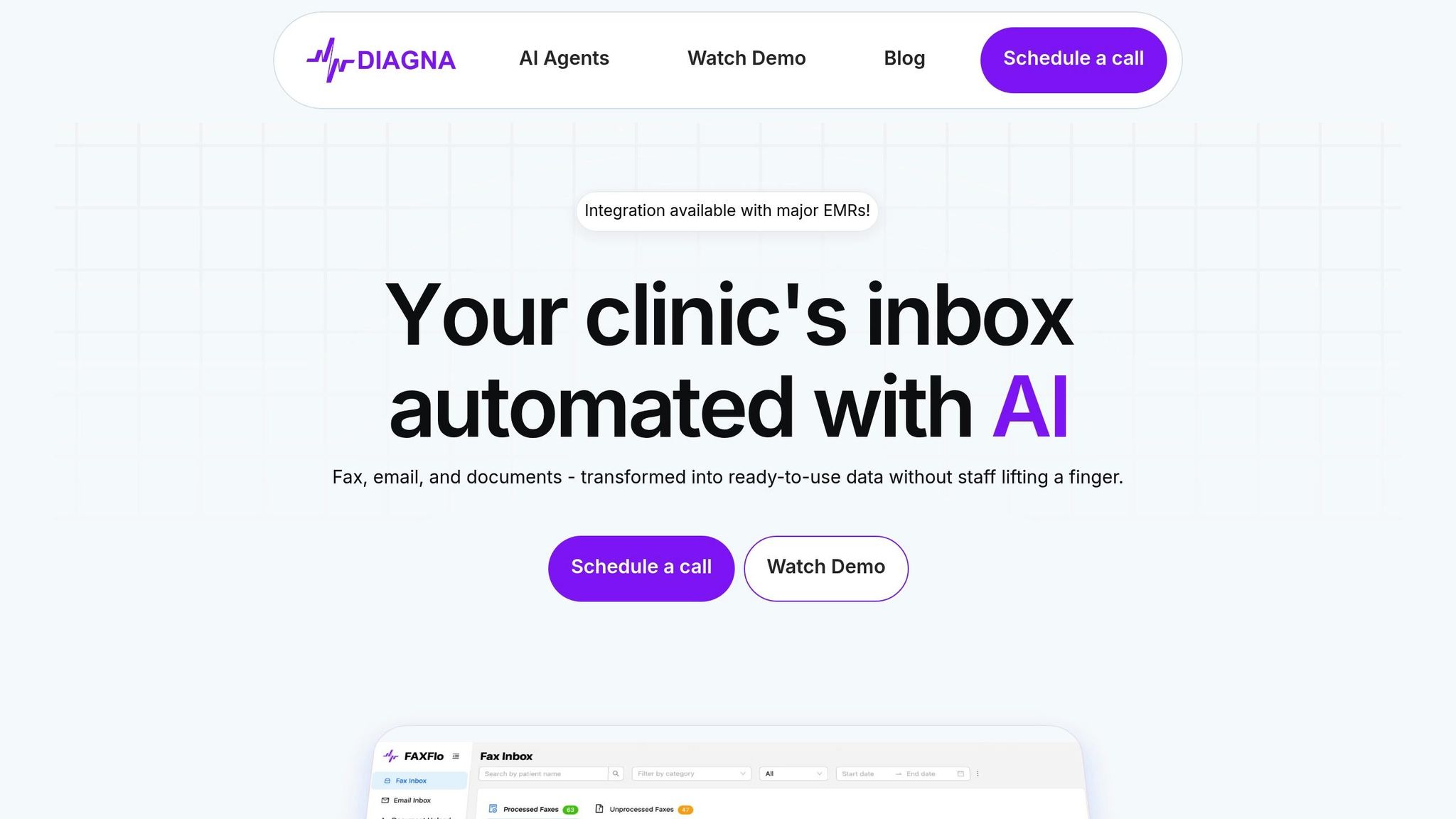
Diagna provides a great example of how AI can transform workflows. Their platform includes tools like:
FAXFlo: Automatically organizes and prioritizes incoming faxes.
Prior Auth Bot: Extracts clinical data to populate authorization forms.
Referral Manager: Tracks requests in real time and sends automated follow-ups.
These tools create a seamless workflow that integrates with any electronic medical records system, ensuring HIPAA compliance and facilitating smooth team collaboration.
AI Automation vs. Manual Processes
When comparing traditional manual processes to AI-powered automation, the advantages of AI become evident. For instance, manual prior authorization tasks require physicians and staff to dedicate an average of 13 hours per week for a single physician. In contrast, AI automation can handle about 80% of approvals automatically, leaving staff to focus on the remaining 20% that need closer attention.
Feature | Manual Prior Authorization | AI-Powered Automation |
|---|---|---|
Processing Time | Days to weeks for decisions | Hours for most requests |
Error Rate | High due to manual entry | Lowered with automated accuracy checks |
Administrative Cost | Significant, estimated at $450 million annually | Reduced costs through streamlined workflows |
Staff Productivity | 13 hours per week per physician | Frees staff for patient care |
Consistency | Varies by staff experience | Standardized across all requests |
Scalability | Limited by staff availability | Handles higher volumes with ease |
For example, Blue Cross Blue Shield of Massachusetts integrated AI into its prior authorization system to reduce unnecessary denials. By using predictive analytics, they identified potential issues before submission, which improved approval rates and reduced the need for appeals.
"The goal was to maintain the value of prior authorizations while eliminating administrative burden and speeding up care for members." - Kathy Gardner, RN, vice president of clinical operations at Blue Cross Blue Shield of Massachusetts
The financial benefits of AI automation go beyond cutting administrative costs. Electronic prior authorizations could save organizations around $450 million annually. At the same time, these systems address patient care challenges - 94% of patients report experiencing delays due to prior authorization issues.
Connecting Automation with EMR and Clinical Systems
Integrating automation tools with existing EMR systems is a must to avoid the chaos of disconnected tools that only add to administrative workloads. By aligning these tools with the goal of reducing prior authorization delays, healthcare organizations can build AI-powered workflows that integrate seamlessly with the clinical systems used daily. Below, we’ll explore some key practices for achieving smooth integration.
Best Practices for EMR Integration
When linking AI tools to EMR systems, sticking to standardized data exchange protocols is critical. Many integrations rely on widely accepted standards like HL7 FHIR, which ensure smooth communication between different healthcare systems. Using these protocols allows patient data to flow automatically between the EMR and AI-driven authorization tools.
Another cornerstone of successful integration is adopting an API-first approach. Instead of depending on manual file transfers or basic data exports, platforms with robust APIs enable real-time data synchronization. For instance, if a physician updates a patient’s record, the prior authorization tool can immediately access the latest information, keeping workflows up-to-date.
Security is non-negotiable when it comes to integration. Features like single sign-on (SSO) let staff access both EMR and AI tools using their existing login credentials, simplifying access without compromising security. Role-based access controls further enhance security by ensuring team members only see the information relevant to their roles.
Lastly, planning for data mapping and field customization is essential. This ensures that AI tools can interpret and process various data formats correctly, which is key for automating tasks like form filling.
Benefits of Real-Time Data and Unified Workflows
Real-time integration eliminates the hassle of duplicate data entry. When prior authorization requests automatically pull patient demographics, insurance details, and clinical information directly from the EMR, staff can skip the time-consuming task of re-entering data manually.
This kind of integration also flags missing or outdated information instantly, reducing the need for rework. By keeping data flowing seamlessly, AI tools can further minimize manual errors.
Unified workflows are another major advantage. With AI systems automatically updating as changes occur in the EMR, everyone - from specialists to primary care doctors and administrative teams - works from the same current data. This synchronization cuts down on confusion and prevents delays caused by outdated or conflicting information.
Additionally, organizations gain the ability to monitor authorization approval rates and spot trends, which can help refine future processes and make them even more efficient.
How Diagna Works with Any EMR
Diagna’s platform is a great example of how modern AI tools can integrate smoothly with existing healthcare systems. Designed to work with any EMR, the platform simplifies workflows and keeps everything connected.
One standout feature is its unified inbox, which pulls data from multiple sources - such as EMR records, incoming faxes, and prior authorization forms - into a single interface. This reduces the need to switch between applications, saving time and ensuring critical tasks don’t fall through the cracks.
Diagna also uses smart document classification to organize incoming information and link it to the appropriate patient records, making reviews more efficient and complete.
Throughout the integration process, Diagna maintains HIPAA compliance, ensuring patient privacy is protected at every step. Its collaborative design acknowledges that prior authorization involves multiple team members, from physicians to administrative staff, and it supports coordination within the familiar EMR environment. This thoughtful integration approach enhances both task management and overall workflow efficiency.
Improving Workflow and Task Management with AI
AI is reshaping how healthcare teams handle prior authorization workflows, making processes smoother and eliminating common bottlenecks. By leveraging automated data extraction and integrating seamlessly with electronic medical records (EMRs), AI now takes task management to the next level. Instead of relying on manual handoffs or constant status checks, AI-powered systems can automatically route tasks and deliver timely updates, ensuring every step of the process moves forward without unnecessary delays.
Automated Task Assignment and Escalation
In traditional prior authorization workflows, multiple handoffs often create delays and confusion about who is responsible for what. AI changes the game by automatically assigning incoming requests based on predefined workflows. This ensures tasks are routed to the right person or team immediately. Additionally, the system can flag tasks that need extra attention, alerting supervisors to step in when necessary. This approach not only reduces delays but also ensures urgent cases are handled promptly.
Increasing Transparency with Smart Automation
One of the biggest challenges in prior authorization is the lack of visibility into the status of requests. AI addresses this by providing automated updates and using smart document classification to organize payer responses into categories like approvals, denials, or requests for more information. Real-time dashboards give staff a bird’s-eye view of all pending authorizations, helping them prioritize tasks more effectively. This reduces the frustration of patients having to call repeatedly for updates and creates a more transparent system for everyone involved.
Designing AI Tools Clinicians Will Actually Use
For AI tools to succeed in fast-paced clinical settings, they need to be simple and intuitive. Collaborative design plays a key role here, ensuring these tools fit seamlessly into existing workflows rather than forcing an overhaul. Take Diagna’s platform as an example - it consolidates authorization documents and communications into a single, unified inbox. This setup reduces the need to juggle multiple applications, shortens training time, and makes it easier for clinical staff to adopt the system quickly. By prioritizing usability, AI tools can become valuable allies in busy healthcare environments.
Meeting Regulatory Requirements and Data Security
Healthcare organizations managing prior authorization workflows face a dual challenge: complying with strict regulatory standards and safeguarding sensitive patient data. While AI-powered solutions can streamline these processes, they must also align with federal regulations like HIPAA and CMS guidelines. Meeting these requirements is non-negotiable for ensuring both security and compliance.
HIPAA and CMS Compliance
The HIPAA Security Rule outlines specific safeguards - administrative, physical, and technical - that healthcare systems must implement. These include role-based access controls, secure data storage, and detailed audit logging. Meanwhile, CMS regulations emphasize secure data transmission and encryption as essential components of prior authorization systems. AI-enabled platforms used in these workflows need to integrate these measures seamlessly, ensuring encryption at every stage, maintaining secure transmissions, and providing accurate, real-time audit logs to track system activity.
AI-Powered Security Features
AI brings a new layer of sophistication to security protocols. Machine learning algorithms can continuously monitor system activity, identifying unusual access patterns or potential threats in real time. These capabilities complement traditional measures like multi-factor authentication and routine audits, offering enhanced protection against breaches or unauthorized access.
Standard Security vs. AI-Enhanced Security
Security Aspect | Standard Security Measures | AI-Enhanced Security Approaches |
|---|---|---|
Access Control | Role-based permissions with manual oversight | Adaptive controls with continuous monitoring |
Data Protection | Encryption at rest and in transit | Advanced encryption with intelligent data classification |
Audit Compliance | Periodic log reviews and manual checks | Automated audit logging with real-time compliance alerts |
Threat Detection | Reactive measures after incidents | Proactive identification using pattern recognition |
User Authentication | Standard multi-factor authentication | Adaptive authentication based on ongoing risk assessments |
Conclusion: How AI Changes Prior Authorization
AI-powered tools are reshaping how healthcare organizations manage prior authorization, shifting from outdated, manual processes to efficient, automated systems that deliver real results. But the benefits go beyond just saving time - AI is fundamentally changing the healthcare experience for providers, staff, and patients.
The numbers speak for themselves. AI has cut prior authorization processing times by 30% and reduced appeals and reconsiderations by 35%. GuideWell, for example, achieved 78% automated approvals in under 90 seconds using AI solutions. Similarly, Availity AuthAI™ reports that 76% of prior authorization requests receive near real-time approval recommendations. What once took days is now completed in minutes.
For healthcare providers, this means less time spent on administrative tasks. Automated submissions and real-time tracking streamline the process, leading to more accurate submissions, higher approval rates, and fewer costly denials. Staff can focus on what truly matters - patient care - instead of chasing paperwork.
Patients benefit too. Faster approvals mean quicker access to treatments, less stress, and ultimately better health outcomes. It’s a win-win for everyone involved.
From a financial standpoint, AI reduces administrative costs and speeds up care delivery. This allows healthcare organizations to save millions while reallocating resources to initiatives that put patients first.
Diagna’s integrated platform is a prime example of how AI enhances workflows and efficiency. Its system handles everything - from real-time data extraction and payer rule matching to automated submissions - while ensuring HIPAA compliance and audit readiness.
AI is paving the way for a more responsive healthcare system, offering smarter decision-making and improved access to essential data. It’s a step closer to making healthcare truly centered around the patient.
FAQs
×
How can AI automation help speed up prior authorization processing in healthcare?
AI automation speeds up the prior authorization process by handling repetitive tasks such as gathering and submitting data. This reduces the chances of manual errors and enables faster, more precise decisions. With real-time processing, it ensures quicker approvals and improves communication between providers and payers, cutting down on unnecessary delays.
By connecting with electronic medical records (EMRs) and streamlining workflows, AI eases administrative workloads. This allows healthcare professionals to dedicate more time to patient care, ultimately enhancing the experience for both patients and providers.
×
How do AI tools ensure compliance with HIPAA and CMS standards during the prior authorization process?
AI tools used in healthcare are required to meet rigorous HIPAA and CMS standards to protect patient information and stay compliant with regulations. To achieve this, they use advanced encryption techniques to secure sensitive data both during transmission and while it's stored.
These tools also implement stringent access control measures, ensuring that only authorized individuals can view or handle patient data. On top of that, regular audits, compliance reviews, and updates are carried out to keep up with changing regulations and maintain top-tier security practices.
×
How can healthcare organizations use AI tools to streamline workflows and integrate them with existing electronic medical records (EMR) systems?
Integrating AI tools with existing EMR systems can transform how healthcare organizations manage their workflows. By automating repetitive tasks, analyzing patient data in real-time, and cutting down on manual administrative work, these tools can significantly streamline operations. AI can pull data directly from EMRs, process it efficiently, and deliver actionable insights that support better decision-making.
To make this integration seamless, it's crucial to choose AI solutions that align with the current EMR systems in use. Opting for tools with user-friendly interfaces and ensuring staff receive proper training are also key steps. These efforts can help providers save valuable time, reduce errors, and ultimately enhance both patient care and operational efficiency.