Best Healthcare Workflow Automation Tools 2025
Dec 16, 2025
Best Healthcare Workflow Automation Tools 2025
Healthcare automation tools in 2025 are transforming clinics by automating repetitive tasks like patient intake, billing updates, and appointment scheduling. These tools integrate with systems like EHRs and CRMs to improve efficiency and reduce errors. Here’s a quick overview of six key platforms:
Diagna: AI-powered tools for automating faxes, referrals, and prior authorizations. Works with any EMR and offers HIPAA compliance.
Workato: Enterprise-level integration for EHRs, CRMs, and more, with pre-built workflows and strong security features.
Tray.io: A flexible low-code platform for creating custom AI agents and automating across tech stacks.
Zenphi: No-code automation for Google Workspace users, ideal for clinics relying on Gmail, Sheets, and Calendar.
Keragon: Healthcare-specific platform with pre-configured templates for intake, referrals, and billing.
GPTBots: Chatbot-focused platform for patient communication and workflow automation, with HIPAA-grade security.
Each tool caters to different needs, from small practices to large healthcare networks. Below is a comparison to help you decide which platform aligns with your clinic’s goals.
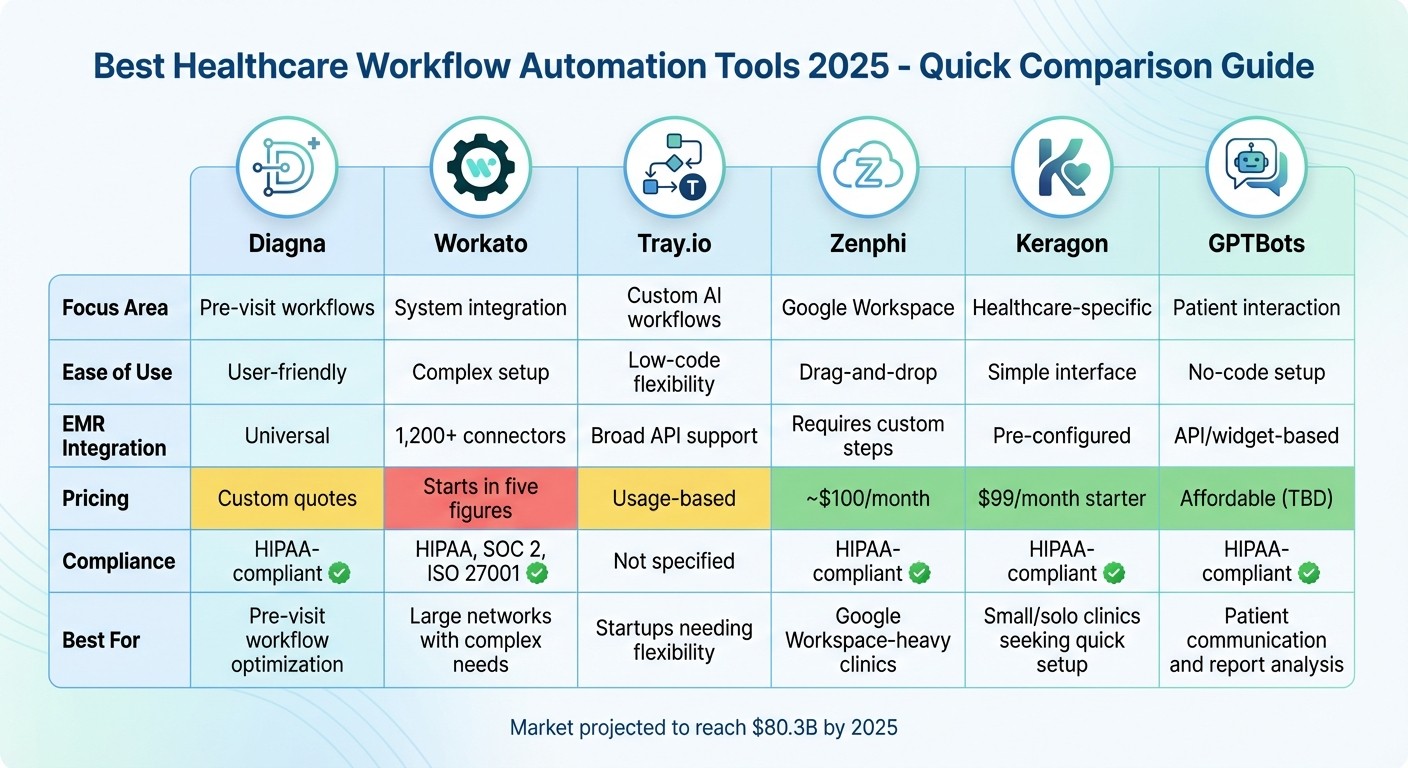
Healthcare Workflow Automation Tools Comparison 2025
20 - AI-Powered Healthcare: Optimizing Clinical Workflows & Patient Care
Quick Comparison
Feature | Diagna | Workato | Tray.io | Zenphi | Keragon | GPTBots |
|---|---|---|---|---|---|---|
Focus Area | Pre-visit workflows | System integration | Custom AI workflows | Google Workspace | Healthcare-specific | Patient interaction |
Ease of Use | User-friendly | Complex setup | Low-code flexibility | Drag-and-drop | Simple interface | No-code setup |
EMR Integration | Universal | 1,200+ connectors | Broad API support | Requires custom steps | Pre-configured | API/widget-based |
Pricing | Custom quotes | Starts in five figures | Usage-based | ~$100/month | $99/month starter | Affordable (TBD) |
Compliance | HIPAA-compliant | HIPAA, SOC 2, ISO 27001 | Not specified | HIPAA-compliant | HIPAA-compliant | HIPAA-compliant |
The right choice depends on your clinic's size, budget, and specific needs. Small practices may prefer Keragon or Zenphi, while larger networks might benefit from Workato or Tray.io. For patient communication, GPTBots is a strong option.
1. Diagna
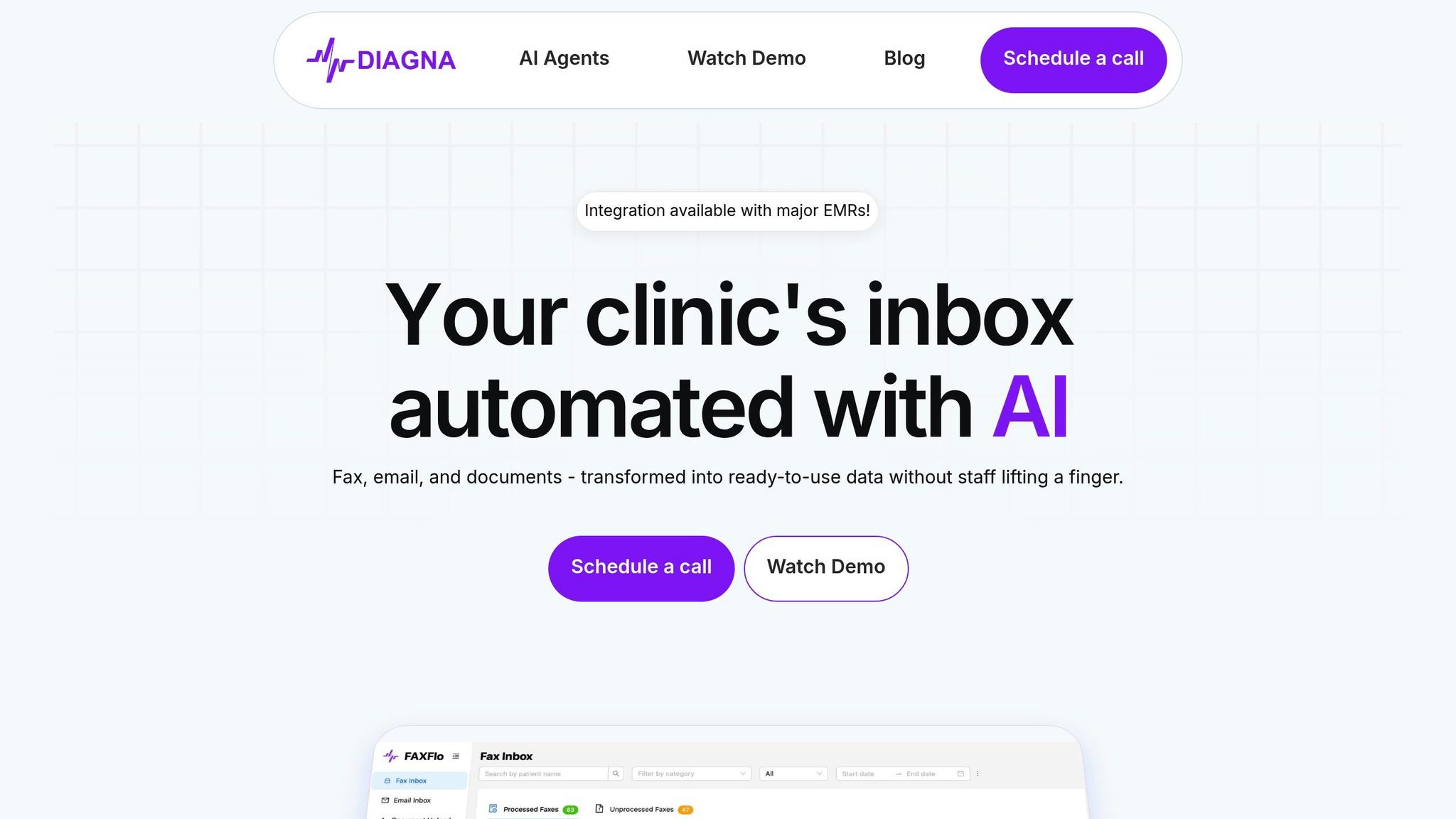
Diagna simplifies pre-visit workflows for clinics by using AI to automate time-consuming tasks. It focuses on managing faxes, referrals, and prior authorizations, reducing the need for manual effort.
Use Cases
Diagna offers three main tools designed to tackle specific challenges:
FAXFlo: Automatically sorts and classifies incoming faxes for easier document management.
Referral Manager: Makes tracking patient referrals more efficient.
Prior Auth Bot: Speeds up the process of completing prior authorization forms.
These tools work together seamlessly, thanks to Diagna's integration with electronic medical records (EMR) systems.
EMR Integration
Diagna connects with any EMR system, ensuring that once documents are processed, they’re directly integrated into your clinic's workflow. Its unified inbox keeps everything organized, eliminating the need for staff to manually transfer information. This means your team can spend less time on administrative tasks and more time focusing on patient care.
Security and Compliance
Built with HIPAA compliance in mind, Diagna prioritizes the security of patient data. Its design allows clinicians to access and review automated workflows while staying within regulatory guidelines.
Pricing and Clinic Fit
Diagna offers flexible plans to suit clinics of all sizes:
Basic Plan: Ideal for small clinics, this plan includes document triage, basic referral tracking, and EMR integration.
Professional Plan: Designed for medium-sized practices, it adds advanced referral tracking and prior authorization automation.
Enterprise Plan: Perfect for large healthcare organizations, this plan includes full automation, custom integrations, and priority support.
Pricing is customized based on the clinic’s size, volume, and workflow needs. You can request a quote to find the best fit for your practice.
2. Workato
Workato is an enterprise integration platform tailored to unify various healthcare systems. Acting as a central hub, it connects electronic health records (EHRs), customer relationship management (CRM) systems, data platforms, and internal services. This makes it a valuable tool for large health systems and digital health vendors looking to streamline their operations.
Use Cases
Workato offers a healthcare-specific hub with pre-built workflows, known as "recipes", that simplify routine tasks like patient intake triage, claims status tracking, and pharmacy order fulfillment. For example, a multi-site specialty group can seamlessly transfer new-patient demographics from online forms into their NextGen EHR system, check insurance eligibility through Change Healthcare, and send a Slack alert if coverage is denied - all within a single automated process. This ability to integrate multiple systems and automate workflows makes it a strong choice for healthcare automation needs.
EMR Integration
With a native HL7 connector, Workato enables clinics to exchange critical information - such as admission, discharge, and lab-result messages - without requiring a separate interface engine. Its drag-and-drop recipe builder allows non-technical staff to create workflows, while IT teams retain control through role-based access and high uptime. The platform's extensive library of prebuilt connectors supports complex and hybrid healthcare environments, bridging diverse system architectures with ease.
Security and Compliance
Workato meets stringent security and compliance standards, holding certifications like SOC 2 Type II, ISO 27001, and PCI DSS. It also undergoes annual third-party HIPAA attestations and offers streamlined BAA execution to protect both clinical and payment data. Additional security measures, such as role-based access, granular environment controls, and detailed audit logs, provide an extra layer of protection for sensitive information.
Pricing and Clinic Fit
Workato's pricing is designed for mid-market and enterprise organizations. Starter subscriptions typically begin in the low five-figure range annually and scale based on the number of recipes and task volume. While this pricing might not suit small solo practices, it can be a worthwhile investment for growing provider networks or venture-backed telehealth companies. The platform's extensive connectors and strong security features make it a compelling option for organizations with complex integration needs.
3. Tray.io
Tray.io is an AI orchestration platform built on an AI-ready iPaaS (Integration Platform as a Service). Instead of focusing solely on healthcare, it provides a flexible framework for creating custom AI agents capable of automating workflows across an organization’s entire tech stack. With support for over 621 integrations and serving more than 1 million users, Tray.io offers extensive connectivity that can also extend to healthcare systems. By leveraging automation trends, the platform equips users with powerful AI tools to design workflows tailored to their specific needs.
Use Cases
One standout feature of Tray.io is the Merlin Agent Builder, which enables users to create custom AI agents that maintain context through interactions by utilizing organizational data. The platform also includes Agent Accelerators, which showcase automation patterns that can be applied to various operations, including clinic workflows. For example:
The HR agent handles tasks like PTO requests and policy lookups.
The ITSM agent resolves IT tickets.
The Support agent focuses on triaging and escalating customer issues.
These features make it a versatile tool for streamlining administrative and operational processes.
AI Capabilities and Security
Tray.io’s low-code, AI-augmented builder simplifies integration development with its AI Palette, which allows for rapid prototyping and customization. The platform has delivered measurable results, including a 316% ROI and an 84% improvement in data reporting. Its Tray Agent Gateway offers a controlled environment where IT teams can safely define, manage, and deploy AI agents across the organization, consolidating Multi-Cloud Platform (MCP) capabilities under centralized oversight.
To address security concerns, Tray.io includes the Merlin Guardian feature, which safeguards sensitive data during AI-driven processes. Additionally, its Enterprise Core ensures governance and scalability for all created solutions. However, it’s worth noting that the documentation doesn’t explicitly mention HIPAA compliance or adherence to specific U.S. healthcare regulations. Clinics considering Tray.io should confirm whether it meets their regulatory requirements, as the platform primarily targets broader integration needs rather than healthcare-specific scenarios.
Pricing and Clinic Fit
Tray.io does not publicly disclose its pricing details. Its AI orchestration tools seem particularly suited for organizations with complex integration demands and the technical expertise to develop custom automation workflows. Clinics interested in the platform should directly inquire about pricing options and confirm whether it aligns with their compliance needs and operational scale.
4. Zenphi
Zenphi is a no-code automation platform tailored for Google Workspace users, enabling seamless automation of tasks across Gmail, Drive, Sheets, and Calendar. For healthcare providers, Zenphi can cut administrative time by up to 90% and lower operational costs by as much as 28%. Its deep integration with Google Workspace makes it a natural choice for clinics already relying on Google tools for their daily operations.
Use Cases
Zenphi simplifies processes like patient intake, record management, claims processing, and appointment scheduling. It handles tasks such as collecting forms, securely routing files, extracting and validating data, assigning tasks, and sending notifications. Appointment scheduling becomes effortless with automated request processing, reminders, and calendar updates through Google Calendar and EHR integrations. Administrative tasks like invoice matching, approval workflows, vendor communication, staff scheduling, and leave approvals are also streamlined using AI to process requests and update schedules.
CIT Clinics showcases Zenphi’s scalability and integration capabilities. Delilah Mittermaier, Operations Manager, shares:
"Zenphi is the only automation platform with scalable pricing options we found that's HIPAA-compliant and integrates natively with Google Workspace, as well as with all other tools we're using - Zoho CRM and more".
These enhancements help clinics optimize workflows, though integration with some external systems can pose challenges.
EMR Integration
Zenphi shines within the Google Workspace ecosystem but lacks native support for widely used Electronic Medical Record (EMR) systems like Epic or healthcare data standards such as HL7. Connecting to external EHRs often requires custom HTTP steps or paid connectors, which can add complexity and cost. For clinics heavily reliant on specific EMR systems, this could mean additional time and resources for custom integrations.
AI Capabilities and Security
Zenphi goes beyond basic automation with its AI-driven features, which enhance both data handling and security. Its AI-powered OCR transforms unstructured data, like lab PDFs, into structured formats suitable for billing. AI also supports data extraction for patient intake, claims processing, and digitizing medical records. Additionally, it automates document generation for patient forms, medical reports, invoices, and compliance documents.
Zenphi is fully HIPAA-compliant and offers a Business Associate Agreement (BAA) for organizations handling Protected Health Information, ensuring robust security and privacy measures.
Pricing and Clinic Fit
Zenphi's pricing structure is designed to be flexible and aligns with workflow needs. Unlike platforms that charge per user, Zenphi bases its pricing on the number of workflows being automated. For example, five active workflows cost around $100 per month when billed annually. This approach allows entire teams to collaborate without incurring additional user fees, making it a great fit for healthcare organizations operating on tight budgets.
Zenphi is particularly well-suited for medium-sized healthcare providers that use Google Workspace and require customizable workflows without the complexity of larger enterprise platforms.
5. Keragon
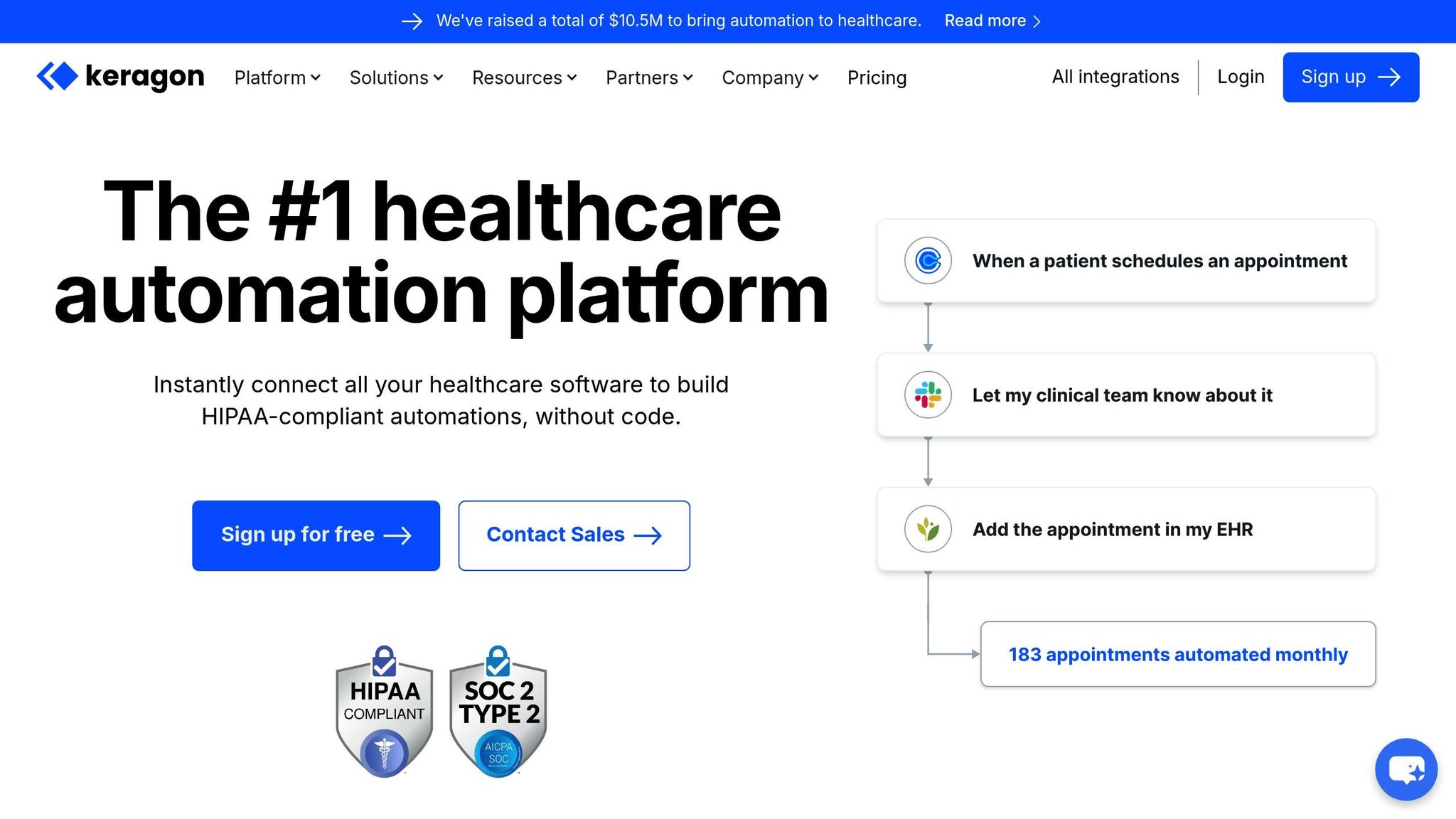
Keragon is a specialized platform designed to simplify healthcare workflows through automation and seamless system integrations. Unlike general-purpose tools, Keragon is built specifically for healthcare, offering over 300 pre-configured integrations with popular cloud-based EHRs like Athenahealth, DrChrono, and Healthie, as well as patient engagement apps and billing gateways. It’s a no-code platform that connects clinical, operational, and administrative systems, making it easier for healthcare providers to streamline their processes. Plus, it’s fully HIPAA- and SOC 2–compliant, ensuring the secure handling of Protected Health Information (PHI).
Use Cases
Keragon is ideal for automating tasks like patient intake, referrals, care coordination, billing, and digital onboarding. For example, a behavioral health clinic on the $99/month Starter plan used a pre-built template to automate syncing intake data into their EHR, emailing preparatory worksheets, and scheduling follow-up reminders. This cut administrative time from 15 minutes to under five. The platform’s drag-and-drop builder lets staff create workflows with features like if/else logic, retries, and error handling - all without needing to write a single line of code. This ensures smooth data flow across clinical systems, saving time and reducing errors.
EMR Integration
Keragon’s pre-built connectors make syncing with EMRs straightforward, eliminating the need for custom API development. These connectors handle tasks like syncing intake forms to cloud EHRs, routing referrals, managing scheduling logic, and coordinating billing and insurance processes. Every step in the workflow builder is pre-configured to securely log and mask PHI, ensuring it meets HIPAA standards.
AI Capabilities
Keragon also incorporates AI-driven features to further enhance efficiency. Mid-tier plans include AI-powered branching, allowing the creation of dynamic patient pathways based on factors like intake responses, clinical conditions, or insurance verification. This minimizes manual decision-making and helps streamline operations even further.
Pricing and Clinic Fit
The Starter plan, priced at $99 per month, is tailored for solo clinics. For more advanced needs, such as analytics and AI-driven branching, mid-tier plans are available. Keragon is particularly suited for small to medium-sized healthcare providers looking for automation solutions that are easy to implement and specifically designed for healthcare workflows.
6. GPTBots
Wrapping up our review, GPTBots stands out as a platform designed to enhance patient communication and streamline healthcare operations. This no-code, web-based tool allows healthcare providers to create intelligent chatbots and automate workflows without needing programming skills. By reducing manual tasks and simplifying daily processes, GPTBots helps medical offices move from paper-based systems to efficient digital workflows, making data access and analysis much easier.
Use Cases
GPTBots offers a range of practical applications, particularly in patient interaction. For instance, patients can book or reschedule appointments directly through a chatbot that integrates with WhatsApp, email, or SMS. It even sends automated reminders and syncs with calendars in real time. The platform’s Knowledge Base feature allows users to upload files like PDFs or spreadsheets, enabling the bot to answer common questions about office hours, procedures, or policies instantly.
It also handles initial patient inquiries about insurance coverage, copay amounts, or payment deadlines, seamlessly transferring more complex issues to human staff when needed. In one case, a GPTBots assistant analyzed a patient record, identified elevated blood glucose and HbA1c levels, flagged them as indicative of diabetes mellitus, and recommended further evaluation - all in just seconds.
Overall, GPTBots complements other automation tools by focusing on improving patient communication and operational efficiency.
EMR Integration
GPTBots integrates smoothly with existing EHR/EMR systems, messaging apps, and clinic websites through APIs or widgets. It consolidates data from multiple sources, including lab results, appointment logs, billing records, and external health data, into a unified system. This integration links patient test results to their medical history, aligns appointment schedules with doctor availability, and ensures billing syncs accurately with insurance databases.
AI Capabilities
Powered by advanced language models, GPTBots can process diverse inputs such as text, images, audio, and video. A built-in assistant transforms unstructured patient files into concise case summaries, including details like age, gender, and relevant medical history. The platform improves its performance over time through machine learning, enhancing accuracy and minimizing errors.
Security and Compliance
Security is a top priority for GPTBots, which is built with HIPAA-grade protections. It uses encryption, access logs, audit trails, and role-based access control to safeguard sensitive patient information. The platform also automates record-keeping, flags abnormal clinical values, and identifies potential risks in medication use, ensuring data accuracy and supporting patient safety. Conversation logs are maintained for compliance and easy reference.
Pricing and Clinic Fit
GPTBots is designed to be an affordable solution for healthcare providers of all sizes, from small clinics to large hospitals. Its no-code setup makes it accessible for teams without technical expertise, allowing practices to automate workflows without requiring custom development or extensive IT resources. This practical approach makes it a versatile option for modernizing healthcare operations.
Advantages and Disadvantages
Every automation tool comes with its own set of strengths and challenges, shaped by factors like clinic size, technical know-how, and automation goals. Here's a closer look at what each option brings to the table.
Workato is a powerhouse for enterprise-level needs, boasting over 1,200 pre-built connectors and on-premise agents for secure database access. However, its premium pricing and steep learning curve might make it a tough fit for smaller practices.
Tray.io stands out with its low-code drag-and-drop interface, which also supports custom JavaScript for added flexibility. That said, its consumption-based pricing model can lead to unexpected costs, making careful usage tracking essential.
Zenphi is ideal for clinics heavily invested in Google Workspace. It offers a no-code interface and predictable pricing, starting at about $100 per month for five active workflows when billed annually. However, it may not be the best choice for clinics reliant on non-Google ecosystems.
Keragon is tailored specifically for healthcare, with clinical terminology and templates that significantly cut down administrative time - pilot clinics reported reducing new-patient packet processing from 15 minutes to under five. Its $99 per month starter plan is appealing for solo practices, though advanced features come at a higher cost.
GPTBots focuses on patient communication and clinical report analysis. It offers HIPAA-grade security and multilingual capabilities at an accessible price point, though specific pricing details remain undisclosed.
Below is a quick comparison of key features across these tools:
Feature | Diagna | Workato | Tray.io | Zenphi | Keragon | GPTBots |
|---|---|---|---|---|---|---|
EMR Integration | Works with any EMR seamlessly | 1,200+ connectors, on-premise agents | Broad API support, custom code | Native Google Workspace integration | Healthcare-specific templates and connectors | APIs/widgets for HIS, EMR, telemedicine |
Ease of Setup | Web-based, clinician-designed | Visual builder but complex | Low-code canvas, needs oversight | No-code, drag-and-drop | Simple, Zapier-like interface | No-code, prebuilt templates |
Pricing Model | Not specified | Premium, scales by recipe/task | Usage-based, costs can rise | ~$100/month for 5 workflows | $99/month starter, usage-based tiers | Affordable; pricing not disclosed |
Best For | Pre-visit workflow optimization | Large networks with complex needs | Startups needing flexibility | Google Workspace-heavy clinics | Small/solo clinics seeking quick setup | Patient communication and report analysis |
Key Limitation | Limited pricing transparency | High cost, steep learning curve | Unpredictable costs | Limited compatibility outside Google | Advanced features require higher tiers | No clear limitations documented |
Automation investments continue to grow, with over 80% of organizations planning to maintain or increase spending due to clear efficiency improvements. The global healthcare automation market is on track to hit $80.3 billion by 2025. The right tool for your clinic will depend on balancing upfront costs, technical complexity, and scalability with your clinic's most pressing workflow challenges.
Conclusion
When choosing the right automation tool for your clinic, it's essential to focus on your specific needs and priorities. For small practices, Keragon offers no-code templates tailored to healthcare workflows. If your clinic already uses Google Workspace, Zenphi provides seamless, HIPAA-compliant integration. Mid-sized clinics looking for a balance between customization and ease of use may find Tray.io's low-code platform a great fit. For improving patient communication, GPTBots stands out, while large healthcare networks requiring complex integrations can benefit from Workato's extensive library of connectors.
As healthcare automation becomes more prevalent, selecting a platform that eliminates your most time-consuming manual tasks is key. The tools discussed here aim to streamline operations, improve accuracy, and free up your team to focus on what truly matters - patient care. By addressing your clinic's unique workflow challenges and considering factors like ease of implementation, budget, and technical requirements, you can find the solution that best supports your goals. Whether you're prioritizing simplicity, healthcare-specific features, or enterprise-level capabilities, the right tool will help you enhance both efficiency and patient outcomes.
FAQs
×
What should I look for in a healthcare workflow automation tool for my clinic?
When choosing a healthcare workflow automation tool, it's crucial to ensure it integrates smoothly with your existing EMR system. This helps prevent workflow disruptions and keeps operations running efficiently. Prioritize tools with AI-driven features that handle tasks like documentation and repetitive processes, saving time and reducing manual effort.
Don't overlook HIPAA compliance - it's a must for protecting patient data. Also, check for strong security protocols to guard sensitive information against potential breaches.
The tool should be easy for your team to use, capable of scaling as your clinic grows, and backed by a dependable vendor with responsive customer support. These elements are key to finding a solution that boosts efficiency while addressing your clinic's unique requirements.
×
How do these automation tools stay compliant with healthcare regulations like HIPAA?
These tools are built to align with HIPAA standards by employing data encryption to protect health information (PHI) whether it’s being transmitted or stored. They incorporate role-based access controls to restrict sensitive data access, maintain comprehensive audit logs to monitor activity, and ensure compliance by entering into Business Associate Agreements (BAAs) with healthcare providers.
On top of that, they operate on HIPAA-compliant infrastructure designed to meet rigorous security requirements, often verified through certifications like SOC 2 or HITRUST. These safeguards protect patient information while enabling smooth and compliant workflow automation.
×
What factors influence the cost of implementing healthcare workflow automation tools?
The cost of adopting healthcare workflow automation tools in 2025 varies based on several key factors. For starters, platform licensing fees can range from as low as $99 per month for smaller practices to over $10,000 annually for larger organizations. Beyond that, you might face costs for integration and customization to tailor the system to your clinic's specific operations. Ensuring HIPAA compliance is another critical expense, which could involve secure cloud hosting or setting up on-premises infrastructure.
You’ll also want to account for data migration expenses, ongoing maintenance and support, and essential security measures like encryption and signing Business Associate Agreements (BAAs). By taking these elements into account, you can create a budget that supports your clinic's goals while staying financially prepared.